3D-Printed Models for Clear Aligners: Hollow or Solid, and How Thick Should the Walls Be?
Most in-house clear aligners are still made the same way: a model is printed for each treatment step and a plastic sheet is heat-formed over it (thermoforming). An aligner can never be more accurate than the model underneath it. If the model is off by a few tenths of a millimetre, the planned tooth movement is off too. In this article we go through the settings that decide model accuracy one by one: printer and resin, layer thickness, hollow versus solid printing, wall thickness, base design, build angle, post-curing, and how long a model can wait before thermoforming. At the end we briefly look at directly printed aligners. All numbers come from studies with a DOI; none of them were obtained with 3mash printers or resins, and each belongs to the printer, resin and test conditions of the study named.
How accurate does a clear aligner model need to be?
Model accuracy is described with two measures: trueness shows how close the printed model is to the digital file, and precision shows how similar models printed from the same file are to each other. Deviation is usually reported as an RMS (root mean square) value in millimetres or micrometres (µm).
The clinical limit used most often in aligner studies is 0.25 mm. Bor and Oğuz (2025) explain that it comes from the orthodontic literature, where the maximum planned tooth movement per aligner is 0.25–0.30 mm. In other words, if the model error is as large as the movement one aligner is supposed to deliver, the aligner cannot do its job. Some studies used 0.30 mm (Bennett and DiGiovanni, 2024), and some looked at a tighter 0.10 mm range (Liu et al., 2026).
How do printer technology and resin affect model accuracy?
Grassia et al. (2023) note that vat photopolymerization, curing resin in a tank with light, is the most popular printing method for dental and orthodontic work. Depending on the light source, these printers are grouped as SLA (laser), DLP (projector) and LCD/MSLA (masked screen). The common finding is that, used with the right settings, all of these technologies can produce models good enough for aligner fabrication; the printer, resin and workflow together decide the result more than the technology label does.
Grassia et al. (2023): 80 models were printed at 50 µm on two SLA printers, one DLP printer (Asiga Pro 4K65) and one LCD printer (Anycubic Photon M3), each with the resin, settings and curing unit recommended by its manufacturer. A crowded and a spaced dentition were tested. The printers differed from one another, but trueness and precision errors stayed below the 0.25 mm clinical limit for every printer. The authors conclude that all tested printers produced models suitable for clear aligner fabrication.
Bor and Oğuz (2025): 504 models were printed on an Anycubic Photon Mono 7 Pro 14K LCD printer with four resins, three print designs and two layer thicknesses. Mean trueness deviation ranged from 0.094 to 0.152 mm depending on the group, and the effect of resin was statistically significant. Even so, every resin, design and layer combination stayed below the 0.25 mm limit.
Naeem et al. (2022): For directly printed clear retainers, SLA, DLP, continuous DLP and PolyJet printers were all found clinically acceptable and accurate against a 0.25 mm criterion.
The practical lesson: on the same printer, a different resin gives a different result. Choosing a model resin that matches your printer and following the manufacturer's exposure, washing and curing advice matters at least as much as the choice of printer. We cover what to look for in a model resin in our dental model resin article (in Turkish).
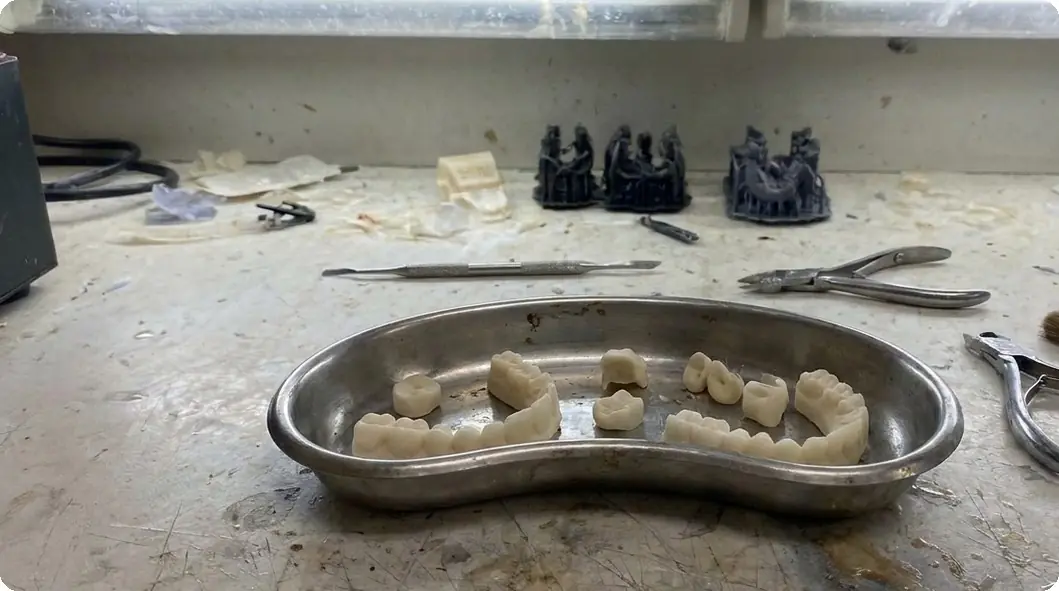
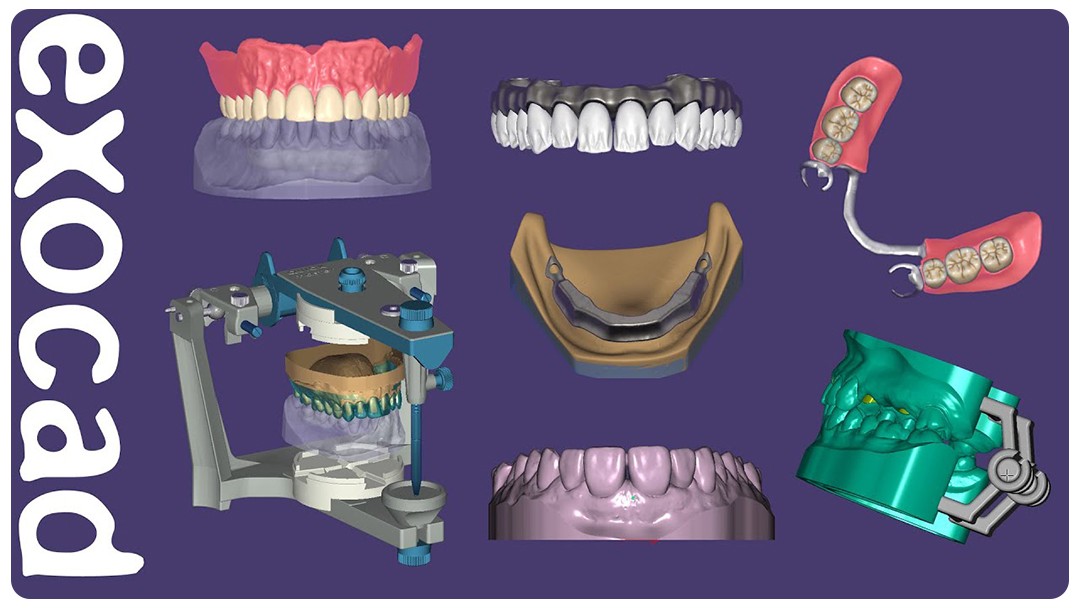
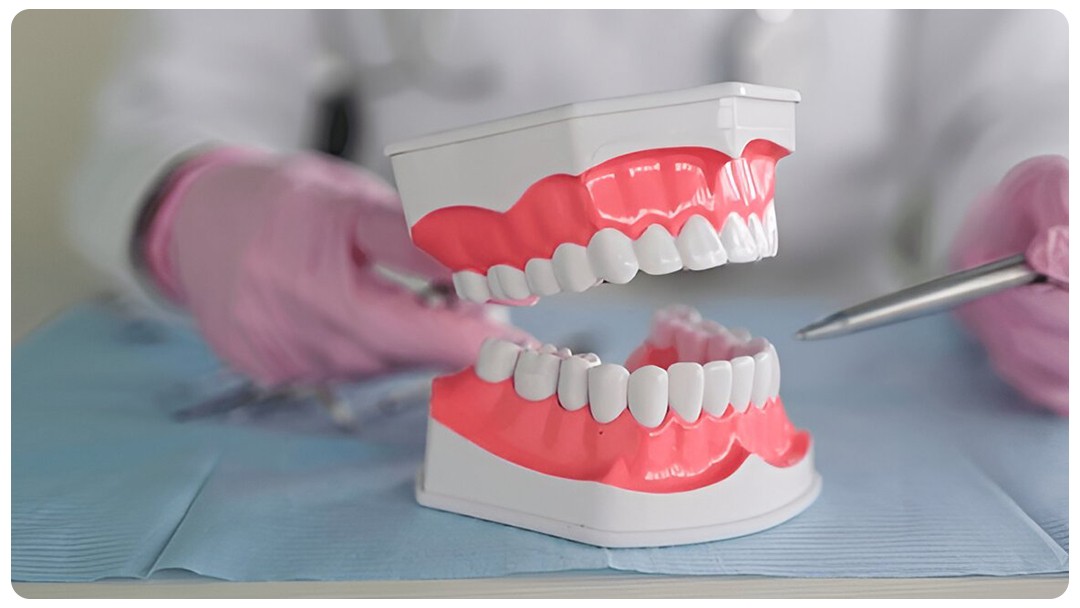
Printed dental models
Figure 1: Printed dental models
Layer thickness: 50 µm or 100 µm?
Layer thickness is the height of the resin layer the printer cures in each step. Thinner layers promise a smoother surface but take longer to print.
Bor and Oğuz (2025): In vertically printed models, 100 µm layers generally gave better trueness than 50 µm. The authors attribute this to errors adding up over the larger number of layers at 50 µm and to the peel forces between film and platform at every layer. They also note that the effect depended on resin and design; a further benefit of 100 µm is the shorter print time.
Grassia et al. (2023), on the other hand, chose 50 µm as the most balanced layer thickness for aligner models, and Chen et al. (2026) and Liu et al. (2026) also printed at 50 µm.
In short, there is no single right value for every printer and resin. Start with the layer thickness the resin manufacturer recommends and check your own models.
Hollow or solid model? How thick should the walls be?
A hollow model keeps an outer shell of a set wall thickness and leaves the inside empty. It saves resin and print time, but because the plastic sheet is pressed onto the model with heat and pressure during thermoforming, the wall has to be thick enough to take that load.
Bennett and DiGiovanni (2024): Hollow models with 0.5, 1.0, 1.5 and 2.0 mm walls and solid models were printed on a Form 3B (SLA) printer with Model V2 resin (10 per group). Aligners were thermoformed on a Biostar V with 0.030-inch acrylic sheets. Four of the ten 0.5 mm models did not survive thermoforming. The share of points on the aligner's inner surface within ±0.30 mm was 27.56% for 0.5 mm, 75.66% for 1.0 mm, 80.38% for 1.5 mm, 86.82% for 2.0 mm and 96.45% for solid models. The difference between 2.0 mm and solid was not statistically significant. For this model, a 2.0 mm wall used 44% less resin than a solid model.
Kenning et al. (2021): Appliances were thermoformed on hollow models with 1.0, 1.5, 2.0, 2.5 and 3.0 mm shells and on solid models (10 per group). Appliances from 1.0 and 1.5 mm models showed poor accuracy, with a significantly lower share of points within ±0.25 mm than those from models of 2.0 mm and thicker. The authors recommend a minimum shell thickness of 2.0 mm for the materials tested.
Liu et al. (2026): Hollow models with 2.0 mm walls printed on a DLP printer were within the clinical limit on day 1 but began to deviate significantly from day 7. Solid models stayed stable for 28 days. All designs still remained below 100 µm.
Chen et al. (2026): Hollow with a perforated base, solid, and support-structure internal designs were compared; internal design had no significant effect on dimensional stability over 4 weeks.
Taken together: if you print hollow, make the wall at least 2 mm; thinner walls can collapse during thermoforming and spoil the aligner's fit. If the model will wait more than a few days, the Liu et al. (2026) findings suggest a solid design may be safer.
How should the model base be designed?
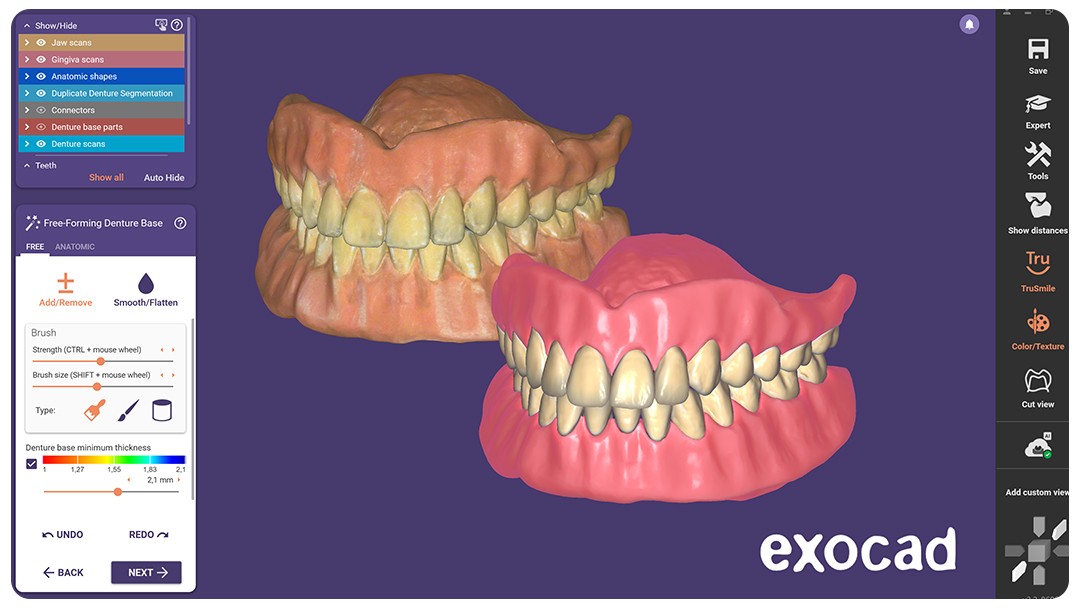
For aligner models the palate is usually removed and the model is printed as a horseshoe. This saves resin and makes thermoforming easier, but a thin, open arch can change shape during printing if it is not supported.
Liu et al. (2026): Four designs were compared on a Wisdom1 DLP printer with GV-Model 1 resin: full-palate solid, full-palate hollow, horseshoe solid and horseshoe hollow. On day 1 the horseshoe solid model had the best trueness (31.40 µm). Compared with the full-palate solid model, the horseshoe solid design cut print time by 19% and resin use by 30%, and it stayed stable for 28 days.
Bor and Oğuz (2025): Horseshoe models with an extended posterior section or a posterior connector bar were more accurate than models printed on supports. The authors note that these designs made extra supports unnecessary and avoided deviations caused by support marks.
It can, but in the studies the differences stayed inside the clinical limit.
Chand et al. (2026): 112 models were printed on a SprintRay Pro DLP printer at 0°, 30°, 60° and 90°. For maxillary models the mean deviation was 0.1215 mm at 0°, 0.0862 mm at 30°, 0.0967 mm at 60° and 0.1234 mm at 90°; 30° and 60° were significantly better. For mandibular models there was no significant difference between angles. All models stayed within ±0.25 mm, and the authors say the angle can be chosen based on clinical needs, print time, resin use and platform efficiency.
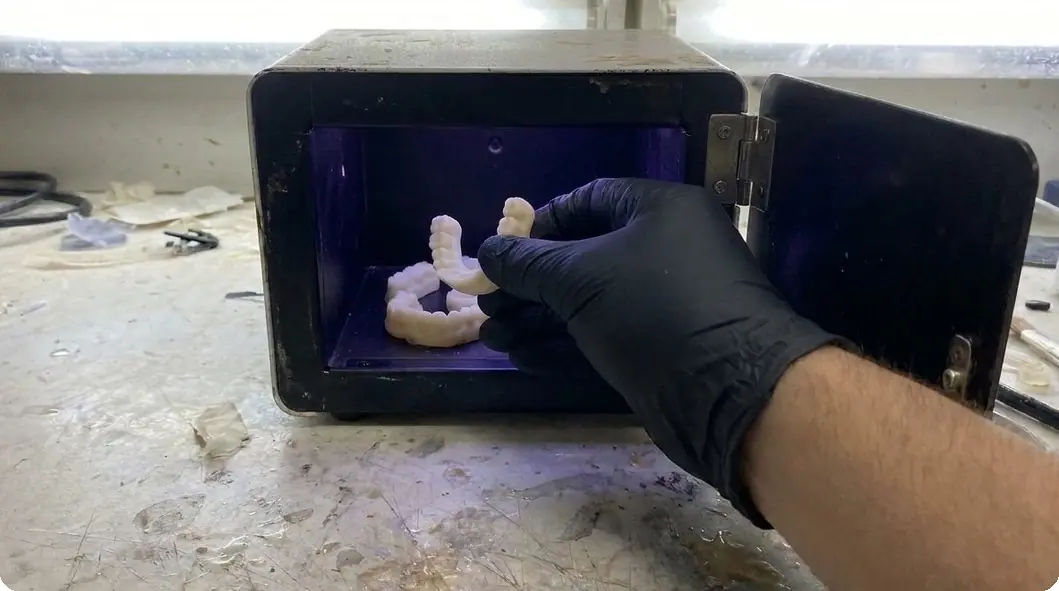
Post-curing is the second polymerization of the washed print with light; only after this step does the model reach its final hardness and dimensions. In every model study reviewed here, washing and post-curing were done with the unit and times recommended by the printer and resin manufacturer. Grassia et al. (2023) used each printer with its manufacturer's own curing unit, and Chen et al. (2026) followed the manufacturer's protocol in both workflows.
Exposure during printing also affects size. Bor and Oğuz (2025) point out that overexposure can round off fine detail and enlarge the model, while underexposure can cause shrinkage and a weak structure; this is why calibration prints were made for each resin before the study.
How long can a printed model wait before thermoforming?
Resin models can still change size slightly after printing. A model used straight away and one left on the shelf for weeks may not give the same result.
Chen et al. (2026): 60 models were printed with two printer–resin workflows and scanned 7 times over 4 weeks under controlled indoor conditions. In one of the workflows, trueness decreased significantly after week 2 for the solid and support designs and after week 3 for the hollow design, while precision did not change. The other workflow showed no significant change over 4 weeks. The authors stress that the two workflows differed not only in curing mechanism but also in resin composition, exposure settings and post-processing, so the difference should not be attributed to printing technology alone. For that study's workflow, they recommend using the models within 2 weeks.
Liu et al. (2026): Models were stored dry, in the dark, at 20 °C and 50% humidity. Solid models stayed stable for 28 days, while hollow models began to deviate after day 7.
In practice, the safest approach is to thermoform the aligners soon after printing and post-processing, and to keep models away from light, heat and moisture. For models that will be stored or shipped for longer, check the data from your resin's manufacturer.
How well does a thermoformed aligner fit the model?
A thermoformed aligner is only as accurate as the model it is formed on. Bennett and DiGiovanni (2024) scanned the inner surface of each aligner with an intraoral scanner and compared it with the original file: 96.45% of points were within ±0.30 mm for aligners made on solid models and 86.82% for those made on 2.0 mm models. The authors note that it was visibly obvious the aligners from 0.5 mm models would not fit, and that 1.0 mm models also showed plastic deformation after thermoforming. Kenning et al. (2021) likewise found that appliances from thin-shell models were less accurate. If the model gives way during thermoforming, the aligner carries that error with it.
Can clear aligners be printed directly?
Yes. With resins developed for aligners, the model and thermoforming steps can be skipped and the aligner printed directly, but the field is still young.
Boo et al. (2025), systematic review: 12 in vitro studies published up to November 2023 were reviewed (5 on retainers, 7 on aligners). According to the review, direct printing with various materials, angles, thicknesses and technologies is feasible, and most techniques worked within the 0.25 mm clinical limit. In one study cited in the review (Koenig et al.), printed aligners had a trueness of 0.14 mm versus 0.188 and 0.209 mm for thermoformed aligners.
Can et al. (2022): Aligners printed with TC-85DAC resin and worn for 1 week by 4 patients were compared with unused aligners. There was no significant difference in Martens hardness (median 91.5 vs 90.5 N/mm²), indentation modulus, elastic index or relaxation index.
These results are encouraging, but samples are small and follow-up is short. More clinical data are needed on thickness, biocompatibility and long-term behaviour of directly printed aligners.
Step by step: how to prepare a clear aligner model
Match resin and settings. Choose a model resin compatible with your printer and start with the resin manufacturer's layer thickness and exposure. In the studies, accuracy changed with the resin even on the same printer.
If you print hollow, make the wall at least 2 mm. Bennett and DiGiovanni (2024) and Kenning et al. (2021) showed that aligner accuracy drops with walls under 2 mm.
Design a stable base. On a horseshoe model, extend the posterior section or add a connector bar; if the model will wait a long time, consider a solid horseshoe design.
Choose the build angle for your printer. In the studies all angles stayed within the clinical limit; start with the orientation the manufacturer recommends.
Wash and post-cure as instructed. Use the solvent, time and curing unit the resin calls for; do not shorten or extend the cycle on your own.
Thermoform without delay. Form the aligners as soon as practical and store models somewhere dry, dark and cool.
Check the first batches. When you switch to a new resin or design, scan a few models and compare them with the digital file; check how the aligner seats on the model and in the mouth.
Why do study results differ?
The studies used different printers, resins, model designs, scanners and software; even the tolerance limit ranged from 0.10 to 0.30 mm. Grassia et al. (2023) and Chen et al. (2026) tested each printer with its own manufacturer's resin and protocol, so the differences they found reflect the combined effect of printer, resin and post-processing and do not show that SLA, DLP or LCD technology is superior on its own. The shared message: models printed on resin 3D printers reach clinically sufficient accuracy for aligner fabrication with the right resin, enough wall thickness and a stable base design.
Conclusion
For a clear aligner model, the key decisions are wall thickness, base design and resin. The studies support at least 2 mm walls for hollow models, a horseshoe base reinforced at the back, and thermoforming soon after printing rather than leaving models to sit. Models printed on SLA, DLP and LCD printers stayed within the 0.25 mm clinical limit in the studies reviewed. When printing models with 3mash 3D printers and dental 3D printer resins, follow the product's own instructions for layer height, exposure, washing and post-curing; for questions, contact the 3mash technical support team.
Frequently asked questions
Can aligner models be printed hollow?
Yes. Bennett and DiGiovanni (2024) and Kenning et al. (2021) obtained clinically acceptable aligners from hollow models with walls of at least 2.0 mm. Thinner walls deformed during thermoforming and reduced aligner accuracy.
What layer thickness should I use for aligner models?
There is no single right value. Bor and Oğuz (2025) found that 100 µm generally beat 50 µm for vertically printed models on an LCD printer, while other studies used 50 µm. Start with the resin manufacturer's recommendation.
How long can a printed model be stored?
It depends on the resin and workflow. Chen et al. (2026) saw a drop in accuracy after 2 weeks in one of the workflows they tested and recommended using models from that workflow within 2 weeks. The safest option is to thermoform soon after printing.
Are models from LCD or DLP printers good enough for aligners?
In the studies reviewed, yes. Grassia et al. (2023) showed that models from SLA, DLP and LCD printers, and Bor and Oğuz (2025) that models from an LCD printer, stayed below the 0.25 mm clinical limit. Because resin and settings clearly affect the result, follow the manufacturer's instructions.
Can aligners be printed directly?
Yes, with resins developed for aligners. According to the review by Boo et al. (2025), most techniques worked within the 0.25 mm limit, and Can et al. (2022) found no significant change in the mechanical properties of aligners worn for 1 week. Long-term clinical data are still limited.
References
Bennett GW, DiGiovanni T. Effect of wall thickness of 3D-printed models on resisting deformation from thermal forming in-office aligners. Clinical and Experimental Dental Research. 2024;10(1):e827. https://doi.org/10.1002/cre2.827
Kenning KB, Risinger DC, English JD, Cozad BE, Harris LM, Ontiveros JC, Kasper FK. Evaluation of the dimensional accuracy of thermoformed appliances taken from 3D printed models with varied shell thicknesses: An in vitro study. International Orthodontics. 2021;19(1):137–146. https://doi.org/10.1016/j.ortho.2021.01.005
Bor S, Oğuz F. Effect of Different Printing Designs and Resin Types on the Accuracy of Orthodontic Model. Polymers. 2025;17(20):2724. https://doi.org/10.3390/polym17202724
Grassia V, Ronsivalle V, Isola G, Nucci L, Leonardi R, Lo Giudice A. Accuracy (trueness and precision) of 3D printed orthodontic models finalized to clear aligners production, testing crowded and spaced dentition. BMC Oral Health. 2023;23:352. https://doi.org/10.1186/s12903-023-03025-8
Naeem OA, Bencharit S, Yang IH, Stilianoudakis SC, Carrico C, Tüfekçi E. Comparison of 3-dimensional printing technologies on the precision, trueness, and accuracy of printed retainers. American Journal of Orthodontics and Dentofacial Orthopedics. 2022;161(4):582–591. https://doi.org/10.1016/j.ajodo.2021.03.016
Chen Y, Li H, Zhai Z, Ge Z, Zhang Y. Effects of Storage Time, Internal Design and Printing Workflow on Accuracy and Stability of 3D-Printed Dental Models. International Dental Journal. 2026;76(5):109747. https://doi.org/10.1016/j.identj.2026.109747
Liu H, Wang J, Zhao Y, Zhang Y, Kou J, Zhang Q, Li K, Wu Y. Effects of Structural Designs on the Accuracy, Dimensional Stability, and Material Consumption of Digital Light Processing-Printed Models. International Dental Journal. 2026;76(5):109738. https://doi.org/10.1016/j.identj.2026.109738
Chand A, K. M H, Saidath K. Evaluation of print angle on accuracy of 3D printed dental models. Frontiers in Dental Medicine. 2026;7:1931793. https://doi.org/10.3389/fdmed.2026.1931793
Boo HS, Sivarajan S, Mohd Tahir NNZ, Bahar AD. Accuracy of three-dimensionally printed retainers and aligners: A systematic review. Journal of Orofacial Orthopedics. 2026;87(2):184–203 (online 2025). https://doi.org/10.1007/s00056-024-00570-x
Can E, Panayi N, Polychronis G, Papageorgiou SN, Zinelis S, Eliades G, Eliades T. In-house 3D-printed aligners: effect of in vivo ageing on mechanical properties. European Journal of Orthodontics. 2022;44(1):51–55. https://doi.org/10.1093/ejo/cjab022