Short answer: Build orientation is the angle at which a part is placed relative to the printer's build platform, and in dental 3D printing it changes accuracy, strength, support volume and print time at the same time. In peer-reviewed studies, 90° or 45° gave more accurate maxillary denture bases, while splints trended better at low angles close to 0°. For flexural strength, the resin type mattered more than orientation. There is no single "best angle": results depend on the printer, the resin and the part, so follow the manufacturer's instructions for your own resin and printer.
Two denture bases printed from the same STL file, with the same resin and printer, can fit differently only because they sat at different angles on the platform. In this article we summarize how build orientation affects dental parts, based on recent studies with DOI numbers. None of the figures below were obtained with 3mash resins or printers; each belongs to the printer and resin conditions of the study it comes from.
What is build orientation in dental 3D printing?
Build orientation is the tilt of the part relative to the build platform. 0° means the part lies flat, parallel to the platform; 90° means it stands upright; 45° is the inclined position in between. When the angle changes, so do the surfaces the layers run parallel to, where and how many supports are placed, how many layers the part has and how tall the build is. Build orientation is therefore not a single setting but a decision that drives several outcomes at once.
Two measurement terms matter for the rest of the article. Trueness is how close the printed part is to the digital design. Precision is how similar parts printed under the same conditions are to each other. Studies usually report this deviation as an RMS or RMSE value in millimetres; the smaller the value, the closer the part is to the design.
How does build orientation affect denture base accuracy?
For denture bases, most studies show that upright or inclined orientations give a more accurate intaglio (tissue) surface than flat printing. The effect, however, varies with the arch and the system.
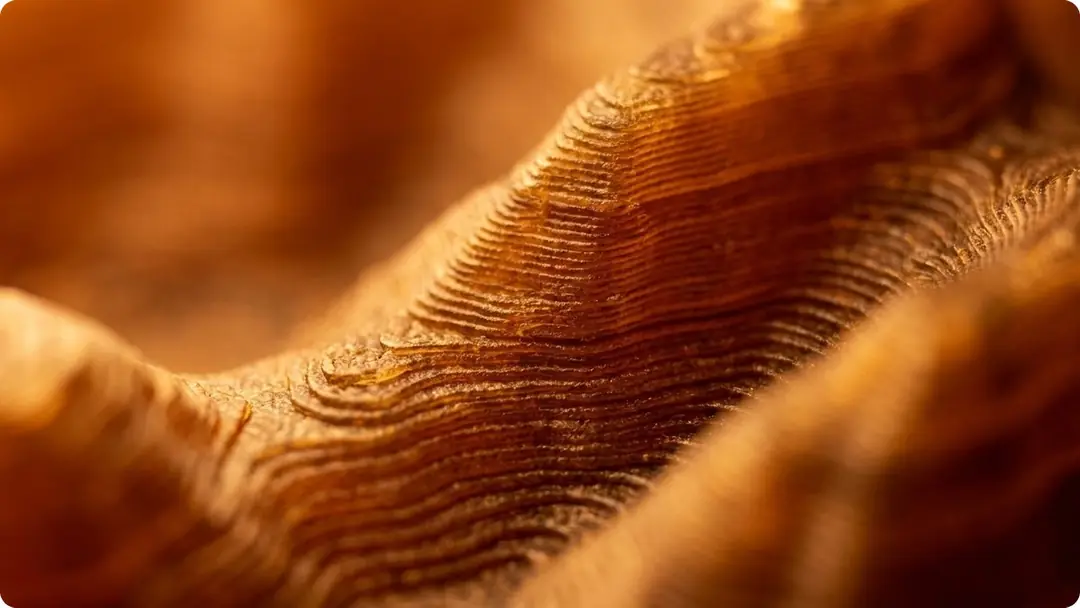
Figure 1: Layer lines
Dzhondrova et al. (2026): For maxillary denture bases printed on a Phrozen Sonic XL 4K Plus MSLA printer with NextDent Denture 3D+ resin, mean deviation (RMSE) was 0.1445 mm at 0°, 0.1409 mm at 45° and 0.1195 mm at 90°. 90° was significantly more accurate than the other two orientations. For mandibular bases there was no significant difference in trueness between orientations, but mandibular bases printed at 90° were less consistent with each other (lower precision). There were only 5 specimens per arch and orientation.
Kim et al. (2025): For maxillary bases printed on a Lilivis Print LCD printer with Tera Harz Denture resin, RMS was highest at 0° (0.1978 mm) and lowest at 90° (0.1630 mm). The share of surface points within a ±50 µm tolerance was 95.32% at 90° and 87.29% at 0°. The 90° group was also the most dimensionally stable during up to 30 days of natural light exposure.
Mizukawa et al. (2026): In a study comparing DLP and LCD printers, the DLP printer achieved its highest trueness at 90°. The LCD printer was more accurate with the manufacturer's recommended resins. Orientation acts together with the printer and the resin, not on its own.
Song et al. (2023): For bases printed in seven orientations on a SprintRay Pro95 DLP printer, the labial 45° and labial 90° groups were the most accurate. Layer thickness (50 or 100 µm) did not significantly change accuracy; it only affected print time.
AlGhamdi and Gad (2024), systematic review: A meta-analysis was not possible because the studies differed widely in printer, resin, layer and curing conditions. The review recommends 45° first, then 90°, for denture bases. Placing supports on the cameo (outer) surface rather than the tissue surface improves accuracy, and support position matters more than support density.
Which angle worked best for splints and surgical guides?
Low angles stood out for splints and intermediate angles for surgical guides. This shows why a "one angle for every part" approach does not work.
Occlusal splints, Hammamy et al. (2026): The same splint resin was printed on two LCD printers and one DLP printer. On all three, deviation increased from 0° to 90°, and the overall effect of orientation was statistically significant. When orientations were compared pairwise, however, the differences were not significant. There is a consistent trend in favour of 0°, but no proven large difference.
Surgical implant guides, Beyer et al. (2025): Seven angles from 0° to 90° in 15° steps were tested on a Formlabs Form 3B (SLA) and a NextDent 5100 (DLP). The SLA printer was most accurate at 15–45° and the DLP printer at 60°. Both systems produced clinically acceptable guides.
Standard specimens, Unkovskiy et al. (2018): For prismatic specimens printed by SLA, 45° was the most accurate orientation. Dimensions along the Z axis (height) were more prone to error; the authors reported deviations of up to 10% along this axis. Parts placed at the edge of the platform were also less accurate than those in the centre.
Does build orientation change flexural strength?
Orientation clearly changes flexural strength for some resins and makes no significant difference for others. Resin type usually has the larger effect.
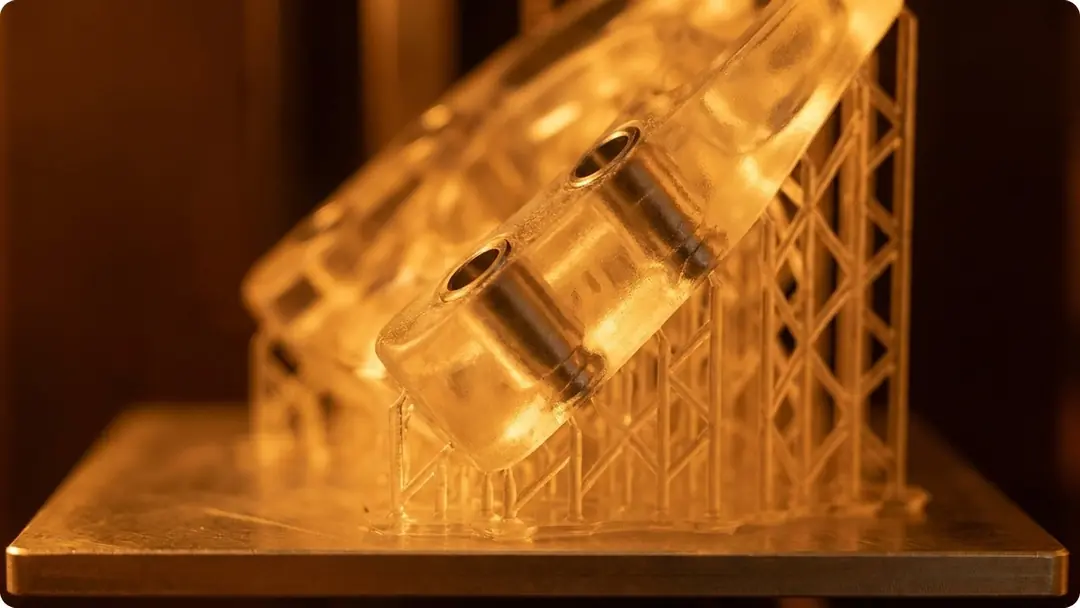
Figure 2: Angled build orientation
Sfondrini et al. (2025) printed 2×2×25 mm bars from seven resins on a single DLP printer (Moon Night) and ran three-point bending tests. Mean flexural strength (MPa, 0° / 45° / 90°) was:
Resin
0°
45°
90°
Significant difference between orientations
Keyguide
111.09
117.93
80.06
Between 45° and 90°
C&B
136.08
107.75
112.11
None
Ivory
67.81
61.23
62.29
None
Vertysguide
134.78
104.47
65.98
90° lower than the others
Bite
5.50
8.30
5.78
None
NextDent Cast
20.02
18.12
13.04
None
Tera
110.27
66.05
57.18
All three differ
The authors conclude that resin type is more decisive than orientation and that the effect of orientation is limited. Still, the table shows that for Keyguide, Vertysguide and Tera, 90° gave significantly lower strength than at least one other orientation. Measured values were below the manufacturer-declared values for some resins; the authors attribute this to specimen geometry, curing and orientation.
Crown and bridge resins show a similar picture. Salonen et al. (2025) reported that, for two temporary/permanent crown and bridge resins printed on an Asiga MAX DLP printer, 90° gave significantly lower flexural strength than 0°, and that 0° should be considered the primary orientation.
There is also an opposite finding: Unkovskiy et al. (2018) found that SLA specimens printed at 90°, with layers parallel to the axial load, had the highest flexural strength. This contradiction shows that strength depends not only on the angle but also on how the layers are aligned to the load, on specimen shape and on the test set-up.
How does build orientation affect supports, print time and resin use?
Upright orientations usually take longer, inclined orientations need more supports, and resin use depends on the system.
Time: As the part becomes more upright, height and layer count increase. In Beyer et al. (2025), printing a surgical guide on the SLA printer took about 100 minutes at 0° and nearly 200 minutes at 90°; on the DLP printer, time rose from 25 to 75 minutes. In Song et al. (2023), print time was shortest at 0° and longest for the 90° orientations.
Resin use: In Beyer et al. (2025), SLA resin use fell at steeper angles and was lowest at about 5.5 mL at 90°; DLP resin use averaged about 10 mL regardless of angle. In Song et al. (2023), the 90° orientations used the least material and labial 45° the most.
Supports: Salonen et al. (2025) reported that 45° required the most support material. In Sfondrini et al. (2025), the same bar was printed with 4 supports at 0° and 45° and a single support at 90°. Because support removal can leave marks on the surface and dimensions of small parts, keeping supports away from functional surfaces is advisable.
How should you choose a build orientation?
Choose the build orientation according to the property that matters most for the part, and verify it on your own printer-resin combination.
Identify the critical surface. The tissue surface for denture bases, the fitting surface for splints, the drill sleeves for surgical guides, and strength and margin fit for crowns and bridges.
Start with the manufacturer's instructions. The orientation and support settings recommended by the resin and printer manufacturer should be the starting point. The study results above were obtained with other printers and resins and cannot be transferred directly to your system.
Keep supports away from the critical surface. According to the systematic review, supports on the cameo (outer) surface improve denture base accuracy.
Account for time and resin use. Upright orientations usually take longer; inclined orientations need more supports. Balance them against your daily workload.
Place parts near the centre of the platform. Unkovskiy et al. (2018) found more deviation in parts at the edge.
Test on your own system. Print a few parts in the chosen orientation and verify fit by scanning or try-in, keeping resin, washing and curing conditions constant.
Why do study results differ from each other?
The studies use different printer technologies (SLA, DLP, LCD), resins, layer thicknesses, support layouts and curing protocols. Sample sizes are often small (5 parts in some groups). These differences are also why the systematic review could not perform a meta-analysis. Rather than taking a single "correct angle" from the literature, verify the trends under your own production conditions. Washing and curing also affect accuracy; see our guide to washing dental 3D prints with IPA. For choosing equipment, our article on what to consider when buying a 3D printer for the dental sector may help, and for guided surgery see surgical guides and implants.
Conclusion
Build orientation in dental 3D printing is a trade-off between accuracy, strength, time and material. In the studies reviewed, 90° and 45° stood out for maxillary denture bases, angles close to 0° for splints, and 15–60° for surgical guides depending on the system, while resin choice was more decisive for flexural strength. For 3mash dental 3D printing resins and 3D printers, follow each product's own instructions for orientation and support settings, and contact the 3mash technical support team with any questions.
Frequently asked questions
What is the best build angle for dental 3D printing?
There is no single best angle. In the studies reviewed, 90° and 45° worked best for maxillary denture bases, low angles for splints, and 15–45° (SLA) or 60° (DLP) for surgical guides. Follow the manufacturer's instructions for your own resin and printer.
Is 90° printing always more accurate?
No. 90° was the most accurate orientation in some denture base studies, but in Dzhondrova et al. (2026) there was no trueness difference for mandibular bases, and mandibular bases printed at 90° were less consistent. For splints, deviation increased from 0° to 90°.
Does build orientation affect part strength?
For some resins, yes. In Sfondrini et al. (2025), 90° gave significantly lower flexural strength than at least one other orientation for Keyguide, Vertysguide and Tera, while the other four resins showed no significant difference between orientations. According to the authors, resin type is more decisive than orientation.
Is layer thickness more important than build orientation?
In Song et al. (2023), 50 and 100 µm layer thicknesses did not significantly change denture base accuracy and only affected print time, whereas orientation changed accuracy, time and material use. This result is specific to that study's printer and resin.
Where should supports be placed?
Keep supports away from the part's functional surfaces. According to the systematic review, placing supports on the cameo (outer) surface of denture bases improves accuracy, and support position matters more than support density.
References
Dzhondrova I, Liondev I, Bogdanov T, Uzunov T, Apostolov N, Todorov R, Kirov D. Effect of Printing Orientation on the Dimensional Accuracy of 3D-Printed Denture Base. Journal of Functional Biomaterials. 2026;17(3):109. https://doi.org/10.3390/jfb17030109
Kim H, Son K, Kim SY, Lee KB. Comparison of the Trueness of Complete Dentures Fabricated Using Liquid Crystal Display 3D Printing According to Build Angle and Natural Light Exposure. Journal of Functional Biomaterials. 2025;16(8):277. https://doi.org/10.3390/jfb16080277
Mizukawa Y, Kawamoto A, Hada T, Iwaki M, Kanazawa M, Takahashi K. Effects of 3D printing systems and orientations on the accuracy of denture bases. Journal of Prosthodontic Research. 2026;70(2):288–296. https://doi.org/10.2186/jpr.JPR_D_24_00307
Song S, Zhang J, Liu M, Li F, Bai S. Effect of build orientation and layer thickness on manufacturing accuracy, printing time, and material consumption of 3D printed complete denture bases. Journal of Dentistry. 2023;130:104435. https://doi.org/10.1016/j.jdent.2023.104435
AlGhamdi MA, Gad MM. Impact of Printing Orientation on the Accuracy of Additively Fabricated Denture Base Materials: A Systematic Review. Dentistry Journal. 2024;12(7):230. https://doi.org/10.3390/dj12070230
Hammamy M, Surathu N, Surathu N, Lawson NC, Dardashtian AC. Impact of Printing Orientation and Printer Type on the Accuracy of 3D-Printed Dental Splints. Materials. 2026;19(11):2266. https://doi.org/10.3390/ma19112266
Beyer M, Scheller L, Burde AV, Abazi S, Sommacal A, Seifert L, Sharma N, Thieringer FM. Comparative Evaluation of SLA and DLP 3D Printing in Dental Implant Guides: Impact on Fabrication Accuracy, Speed, and Resin Usage. Dentistry Journal. 2025;13(10):471. https://doi.org/10.3390/dj13100471
Unkovskiy A, Bui PHB, Schille C, Geis-Gerstorfer J, Huettig F, Spintzyk S. Objects build orientation, positioning, and curing influence dimensional accuracy and flexural properties of stereolithographically printed resin. Dental Materials. 2018;34(12):e324–e333. https://doi.org/10.1016/j.dental.2018.09.011
Sfondrini MF, Pascadopoli M, Cerri M, Todaro C, Gariboldi F, Scribante A. Effect of Printing Angle and Resin Type on the Flexural Strength of 3D-Printed Dental Materials. Applied Sciences. 2025;15(22):11858. https://doi.org/10.3390/app152211858
Salonen R, Garoushi S, Vallittu P, Lassila L. Characterization of temporary and permanent 3D-printed crown and bridge resins. Biomaterial Investigations in Dentistry. 2025;12:68–79. https://doi.org/10.2340/biid.v12.43584