A tooth prepared for a crown or bridge is not left uncovered while the definitive restoration is being made. The provisional restoration worn in the meantime affects both the patient's daily life and the success of the final restoration. In digital workflows, provisional crowns and bridges are now often printed directly from light-cured resins. In this article we look at how well printed provisionals fit, how build angle and post-curing change that fit, what studies found about strength and color change, and how a printed provisional can be relined or repaired, based on publications with a DOI. None of the numbers below were obtained with 3mash printers or resins; each belongs to the printer, resin and test conditions of the study cited.
What is a provisional (interim) crown or bridge?
A provisional (interim) crown or bridge is a restoration placed on prepared teeth for a planned period of time until the definitive restoration is ready. Al Wadei et al. (2022) describe provisional restorations as an integral part of fixed prosthodontic treatment for esthetics, pulp protection, gingival tissue management, keeping the prepared teeth in position, and diagnosis and treatment planning. In full-mouth rehabilitation and implant cases a provisional may have to stay in function for a long time, so its physical and mechanical properties matter too.
Provisional crowns and bridges are made in three main ways today:
Conventional: PMMA (polymethyl methacrylate) or bis-acrylic resin is shaped by hand chairside or in the lab.
CAD/CAM milling: The restoration is milled from a pre-polymerized resin block.
3D printing: The restoration is built layer by layer from a light-curing liquid resin, directly from the digital design. The review by Liang et al. (2025) names vat photopolymerization techniques such as stereolithography (SLA) and digital light processing (DLP) as the main methods in this field, and the studies in the meta-analysis by Saini et al. (2024) also included LCD-based printers.
How well do 3D-printed provisional crowns fit compared with milled and conventional provisionals?
Marginal fit describes how small the gap is between the edge of the restoration and the finish line on the tooth; internal fit describes how closely the inner surface sits on the prepared tooth. A larger marginal gap increases the risk of microleakage, cement dissolution, plaque accumulation and caries, while good internal fit supports retention and durability (Al Wadei et al., 2022).
The most comprehensive answer comes from the systematic review and meta-analysis by Al Wadei et al. (2022). Searching the literature up to June 2022, the authors reviewed 16 laboratory (in vitro) studies qualitatively and included 10 of them in the meta-analysis. They found that:
Provisional crowns and bridges made from 3D-printing resins generally showed better marginal and internal fit than CAD/CAM-milled and conventionally made provisionals. The authors concluded that printed provisionals can be used as a dependable alternative to other resins.
For all three fabrication methods, marginal and internal gaps were within clinically acceptable ranges. In most studies the gaps stayed below the commonly used 120 µm limit.
A few studies reported better fit for milled provisionals; the authors attribute this to the different printer types and print settings used in those studies.
Regardless of fabrication method, discrepancies were higher in three-unit bridges than in single crowns.
In two studies the finish line design also mattered: the smallest marginal discrepancy was seen with a rounded shoulder with a bevel.
Encouraging as this is, the authors note high variability in the data, a high risk of bias and that all included studies were laboratory studies. The result should therefore be read not as "printed provisionals always fit better" but as "with the right printer, resin and settings, printed provisionals can fit as well as, and often better than, milled and conventional ones".
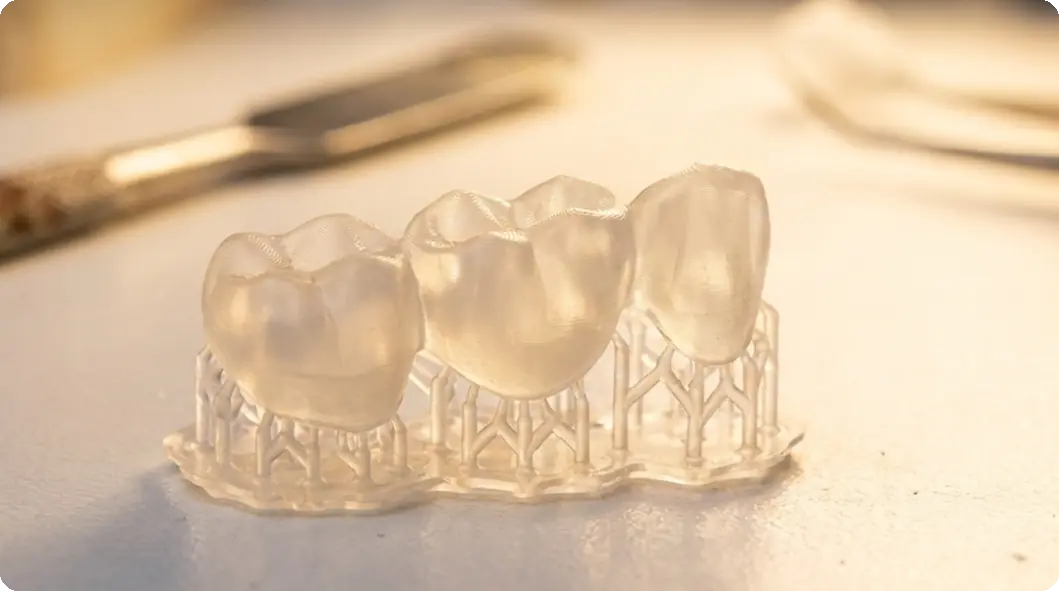
Figure 1: 3D-printed provisional crown
How do build angle and post-curing change the fit of a provisional crown?
Build angle (build orientation) is the tilt at which the part is placed relative to the printer's build platform. It changes the shape of the layers, polymerization shrinkage and where the supports end up. We covered the general picture in our article on build orientation in dental 3D printing; the findings specific to provisional crowns are:
Ryu et al. (2020): A total of 60 premolar crowns were printed at six angles with a DLP-based printer and one provisional crown resin. The marginal gap was 113.6 ± 78.3 µm in the 120° group, versus 58.5 ± 32.3 µm at 150° and 65.1 ± 36.0 µm at 180°. Marginal fit was clinically acceptable at every angle; the best marginal and internal fit was achieved at 150° and 180°. These angle values follow the study's own angle definition; the same number may correspond to a different position in another software or study.
Al-Dulaijan et al. (2024): 260 three-unit provisional bridges were printed with two different provisional resins at 0°, 45° and 90° and post-cured for different times. Both resins produced acceptable internal and marginal fit. The effect of build angle differed by resin: for one resin 0° generally gave better overall fit while 90° gave better marginal fit, and the other resin's marginal fit was consistent across angles. Post-curing time also affected marginal fit, with longer times generally giving better results.
The common message of these two studies is that there is no single "best angle" for everyone. The result depends on the printer, the resin, support placement and post-processing. Ryu et al. (2020) also point out that support position and number can affect internal fit, and that supports placed too close to the margin can damage it during removal. See our guide to support structures for placement, and our article on overcuring and undercuring (in Turkish) for curing effects. Always follow the manufacturer's instructions for your resin for build angle, washing and post-curing time.
How is a 3D-printed provisional crown made? Steps to protect the fit
The sequence below is a general workflow; settings such as time, light and temperature vary by printer and resin, so we do not give numbers here.
Scan and design: Scan the prepared tooth and design the crown or bridge. A clearly defined finish line and a cement space set according to the resin manufacturer's recommendation directly affect fit.
Orientation and supports: Place the part at the angle recommended by the resin manufacturer; keep supports as far as possible from the margins and the intaglio surface.
Print: Print with the layer thickness and printer profile recommended for the resin.
Wash and dry: Remove residual resin using the method recommended by the manufacturer and dry the part completely. Details are in our guide to washing dental 3D prints.
Post-cure: Cure with the unit and time given in the resin's instructions. Incomplete curing can harm both mechanical properties and biocompatibility.
Support removal, polishing or glazing: Clean up support marks and polish the surface or apply a light-cured glaze. See our curing and glazing guide (in Turkish).
Try-in: Check marginal fit and occlusion in the mouth and adjust if needed.
How strong are 3D-printed provisional crowns?
Flexural strength is the highest bending stress a material can withstand before it fractures, and it is the most frequently measured mechanical property of provisional resins. The evidence can be summarized as follows:
Saini et al. (2024): In a systematic review and meta-analysis of 13 studies published between 2016 and 2023, DLP was the most common printing technique; SLA, FDM and LCD-based printers were also used. Flexural strength varied greatly between resins and studies (heterogeneity I² 99%). The authors state that polymerization played a pivotal role in strength.
Alzahrani et al. (2023): In a systematic review of 19 studies, 3D-printed provisional resins showed higher hardness, smoother surfaces, less wear volume loss and higher wear resistance than milled or conventional provisionals, or both. The authors consider printed provisional resins a promising option for crowns and bridges.
Liang et al. (2025): This review reports flexural strength of 60–90 MPa and fracture resistance of 1000–1200 N for printed provisional crowns and bridges, matching or surpassing traditional fabrication methods. The same review stresses that long-term durability, consistency of interlayer bonding, color stability, water sorption and the scarcity of long-term clinical data are still being worked on.
Because strength values depend so much on the resin, build orientation and post-curing, the value on one resin's data sheet should not be compared directly with another resin's.
Do 3D-printed provisional crowns change color?
Color stability is how well a restoration keeps its color as it comes into contact with food and drinks; color difference is usually measured as ΔE00.
Shin et al. (2020): In specimens stored in grape juice, coffee, curry and water for 2, 7 and 30 days in the lab, the 3D printing resins tested at that time changed color significantly more than CAD/CAM blocks and exceeded the clinical limit of 2.25 after 7 days or longer in all experimental groups. Curry was the strongest colorant, and discoloration increased with storage time. The findings belong to the specific resins tested in 2020 and the laboratory conditions of that study.
Nowakowska-Toporowska et al. (2026): Three printing resins for temporary and long-term use were tested in water, coffee and wine for up to 60 days. Material type, surface treatment and storage time all affected color change; post-processing technique had the greatest impact on color stability over time. According to the authors, glazing the surface was the most effective way to maintain color stability.
In practice this means that the longer a provisional is expected to stay in the mouth, the more important polishing or glazing becomes. It also helps to tell patients that coffee, tea and spicy foods can speed up discoloration. See also our article on the resistance of photopolymer resin-based dental prosthetics against harmful substances.
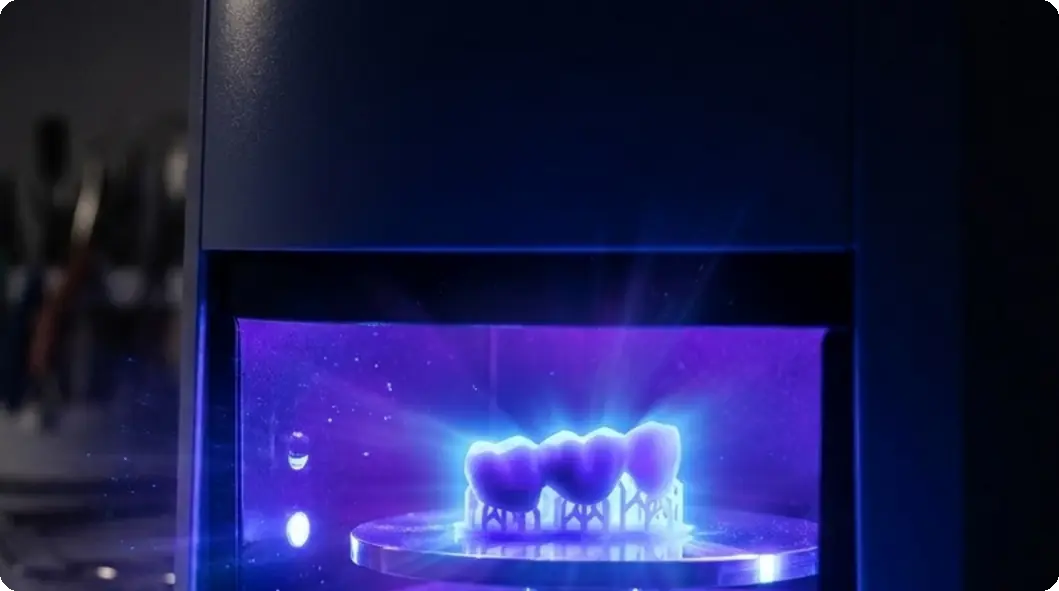
Figure 2: Post-curing
How can a printed provisional crown be relined or repaired?
Relining means adding new resin to the inner surface or margin of a provisional to renew its fit; a fractured provisional or one with an open margin is repaired in a similar way. Palavicini et al. (2023) tested two printing resins designed for long-term provisional crowns with composite, bis-acrylic and PMMA reline materials. For both printed resins, the highest shear bond strength was achieved with the PMMA reline material; bond strength was lower with bis-acrylic or composite. Printed specimens relined with PMMA did not differ significantly from the control group of PMMA relined with PMMA. The authors concluded that the tested printed resins achieved clinically acceptable bond strength when relined with PMMA. Ask the manufacturer of your resin about the recommended surface preparation and reline material.
Why do biocompatibility and post-processing matter?
When polymerization of a light-curing resin is incomplete, unreacted monomer can remain on the surface and in the material. Washing and post-curing are therefore critical not only for strength but also for biocompatibility. Gladrow et al. (2026) showed that post-curing a denture base resin in a nitrogen atmosphere increased the degree of conversion and surface hardness and reduced cytotoxicity without impairing mechanical properties. That study used a denture base resin, not a provisional crown resin, but it clearly shows how post-processing affects biocompatibility. For any resin used in the mouth, the manufacturer's washing, curing and wear-time instructions come first.
What are the limitations of 3D-printed provisionals?
Most of the evidence comes from the lab: The studies in the fit and strength reviews are mainly in vitro; long-term clinical data are still limited (Al Wadei et al., 2022; Liang et al., 2025).
Bridges are more demanding than crowns: Discrepancies were higher in three-unit bridges than in single crowns (Al Wadei et al., 2022).
Results depend on resin and settings: The same angle and curing time can give different results with different resins (Al-Dulaijan et al., 2024); flexural strength varies widely between studies (Saini et al., 2024).
Color can change over time: Discoloration can be noticeable, especially on surfaces that are not polished or glazed (Shin et al., 2020; Nowakowska-Toporowska et al., 2026).
For printers and resins suitable for provisional crown and bridge production, see our 3mash 3D printers and dental resins pages.
Frequently asked questions
Do 3D-printed provisional crowns fit better than milled PMMA provisionals?
In the meta-analysis by Al Wadei et al. (2022), 3D-printed provisionals generally showed better marginal and internal fit than milled and conventional provisionals, and all three methods were within clinically acceptable ranges. A few studies found milling better, which the authors linked to differences in printers and settings.
At what angle should a provisional crown be printed?
There is no single angle that suits everyone. In Ryu et al. (2020), 150° and 180° (by that study's angle definition) gave the best fit, while Al-Dulaijan et al. (2024) showed that the effect of the angle differs by resin. Start with your resin manufacturer's recommendation.
Does post-curing time affect the fit of a provisional crown?
Yes. In Al-Dulaijan et al. (2024), post-curing time affected marginal fit, and longer times generally gave better results. Set the time according to the resin manufacturer's instructions; both overcuring and undercuring can cause problems.
Are 3D-printed provisional crowns strong enough?
In the systematic review by Alzahrani et al. (2023), printed provisional resins showed higher hardness and wear resistance than milled or conventional provisionals, and the review by Liang et al. (2025) reports strength values matching or surpassing traditional methods. Flexural strength, however, varies greatly by resin (Saini et al., 2024).
How can the color of a printed provisional crown be preserved?
Polishing or glazing the surface stands out as the most effective approach (Nowakowska-Toporowska et al., 2026). The effect of colorants such as coffee, wine and curry grows with time (Shin et al., 2020).
Can a fractured or loose printed provisional be repaired?
Yes. In Palavicini et al. (2023), the tested printing resins reached clinically acceptable bond strength when relined with PMMA; bonding with bis-acrylic and composite was weaker.
References
Al Wadei MHD, Sayed ME, Jain S, Aggarwal A, Alqarni H, Gupta SG, et al. Marginal Adaptation and Internal Fit of 3D-Printed Provisional Crowns and Fixed Dental Prosthesis Resins Compared to CAD/CAM-Milled and Conventional Provisional Resins: A Systematic Review and Meta-Analysis. Coatings. 2022;12(11):1777. https://doi.org/10.3390/coatings12111777
Ryu JE, Kim YL, Kong HJ, Chang HS, Jung JH. Marginal and internal fit of 3D printed provisional crowns according to build directions. The Journal of Advanced Prosthodontics. 2020;12(4):225–232. https://doi.org/10.4047/jap.2020.12.4.225
Al-Dulaijan YA, Aldamanhori R, Algaoud H, Alshubaili R, Alkhateeb R, Alalawi H, et al. Internal and marginal fits of 3D-printed provisional prostheses: comparative effect of different printing parameters. Frontiers in Oral Health. 2024;5:1491984. https://doi.org/10.3389/froh.2024.1491984
Saini RS, Gurumurthy V, Quadri SA, Bavabeedu SS, Abdelaziz KM, Okshah A, et al. The flexural strength of 3D-printed provisional restorations fabricated with different resins: a systematic review and meta-analysis. BMC Oral Health. 2024;24(1):66. https://doi.org/10.1186/s12903-023-03826-x
Alzahrani SJ, Hajjaj MS, Azhari AA, Ahmed WM, Yeslam HE, Carvalho RM. Mechanical Properties of Three-Dimensional Printed Provisional Resin Materials for Crown and Fixed Dental Prosthesis: A Systematic Review. Bioengineering. 2023;10(6):663. https://doi.org/10.3390/bioengineering10060663
Liang X, Yu B, Dai Y, Wang Y, Hu M, Zhong HJ, et al. Three-Dimensional Printing Resin-Based Dental Provisional Crowns and Bridges: Recent Progress in Properties, Applications, and Perspectives. Materials. 2025;18(10):2202. https://doi.org/10.3390/ma18102202
Shin JW, Kim JE, Choi YJ, Shin SH, Nam NE, Shim JS, et al. Evaluation of the Color Stability of 3D-Printed Crown and Bridge Materials against Various Sources of Discoloration: An In Vitro Study. Materials. 2020;13(23):5359. https://doi.org/10.3390/ma13235359
Nowakowska-Toporowska A, Raszewski Z, Nowicki A, Weżgowiec J, Kulbacka J, Kijak E. Color Stability of 3D-Printed Dental Resins Following Different Surface Treatments. Polymers. 2026;18(8):901. https://doi.org/10.3390/polym18080901
Palavicini J, Quin SL, Zakkour W, Zakkour K, Manafi Varkiani S, Xu X, et al. Bond Strength of Reline Materials to 3D-Printed Provisional Crown Resins. Polymers. 2023;15(18):3745. https://doi.org/10.3390/polym15183745
Gladrow K, Unkovskiy A, Yassine J, Gaertner N, Topolniak I, Henning N, et al. The effect of nitrogen atmosphere during post-curing on cytotoxicity, polishability, flexural strength, and surface hardness of 3D-printed denture bases: an in vitro study. Journal of Materials Science: Materials in Medicine. 2026;37(1):25. https://doi.org/10.1007/s10856-026-07006-5