How Accurate and Safe Are Directly 3D-Printed Clear Aligners? Shape-Memory Resin, Washing, Curing and Clinical Data
The usual way to make clear aligners is to print a model for each treatment step and heat-form a plastic sheet over it. Over the last few years a method that turns these two steps into one has been spreading: printing the aligner itself directly on a 3D printer, using a resin developed specifically for aligners. In this article we look at what directly printed aligners are made of, how accurate and how thick they come out, how build orientation, layer height, washing and post-curing change the result, how much force they deliver compared with thermoformed aligners, how they change in the mouth and with drinks, what is known about residual monomer and cell compatibility, and what the first clinical results show, using studies with a DOI. None of the numbers were obtained with 3mash printers or resins; each belongs to the printer, resin and test conditions of the study named. Clinical evidence in this field is still limited, and this article is not treatment advice.
What is a directly 3D-printed clear aligner?
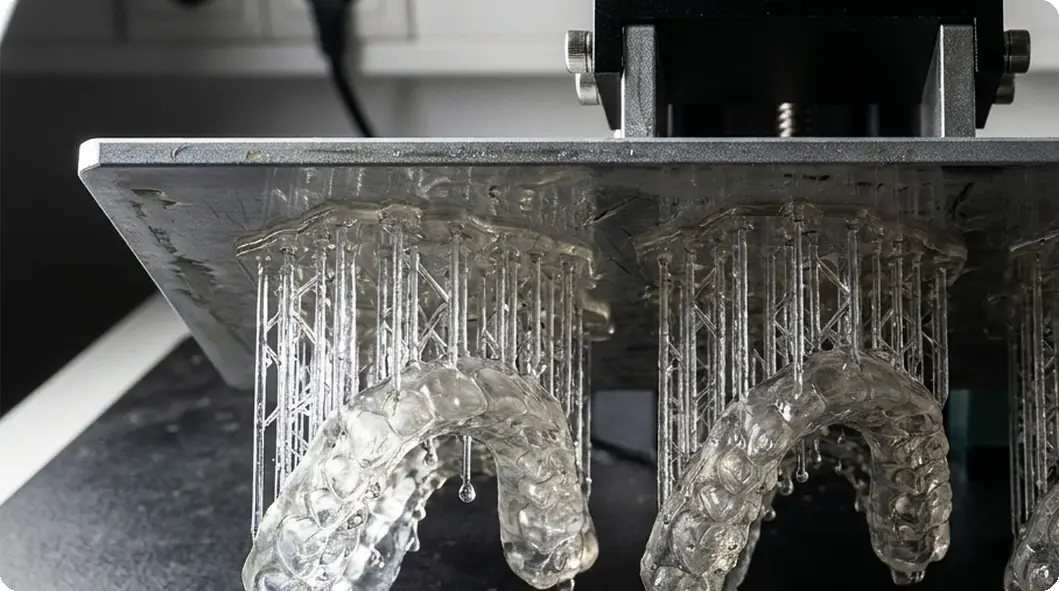
A directly printed aligner is a clear aligner made by printing the aligner file from the digital treatment plan straight from a light-curing resin on a 3D printer, with no intermediate model and no thermoforming step. A thermoformed aligner, by contrast, starts with a printed model of each step; a flat plastic sheet is shaped over that model with heat and pressure and then trimmed. We covered thermoforming and how the models for it should be printed in our article on 3D-printed models for clear aligners; this article focuses on directly printed aligners.
Most peer-reviewed studies used a single commercial material, Graphy's Tera Harz TC-85 resin. Šimunović et al. (2023) found polyurethane and acrylate components in this resin with FTIR analysis, and Willi et al. (2023) described it as aliphatic vinyl ester-urethane monomers with acrylate and/or methacrylate functionalisation. In other words, these aligners are not made from a thermoplastic that melts and re-forms with heat, as thermoforming sheets are, but from a resin that cross-links under light. That difference changes many properties, from thickness to force.
What is a shape-memory resin, and what does it add to an aligner?
A shape-memory resin is a polymer that can be temporarily softened and reshaped with heat and then return by itself to its original printed shape at a suitable temperature. This comes from the material's cross-linked network.
Lee et al. (2022): compared TC-85 with PETG, a common thermoforming material. The glass transition temperature (Tg) of TC-85 was about 30 °C lower than that of PETG, and at 37 °C TC-85 behaved more softly and more viscously than PETG. TC-85 strips bent at 80 °C and cooled recovered about 90% of the deformation within about 10 minutes in 37 °C water and 96% within 60 minutes; PETG did not return to its original shape. The authors suggest these properties may help the aligner apply a continuous light force to the teeth. One of the authors is affiliated with the resin manufacturer's R&D centre, as listed in the paper's author information.
Oyonarte et al. (2026): compared three direct-printing resins, including TC-85, with two thermoforming materials in tensile tests after storage in 37 °C water for up to 14 days. After 14 days the printed resins showed 4.04–7.24 N at 1% strain and the thermoforming materials 26.26–32.91 N. The elongation at break of TC-85 increased by 25.3% after 30 minutes of immersion, while that of the thermoformed materials decreased by 5.5%. The authors note that the printed resins delivered lower mechanical loads, which could favour a more suitable force profile for aligners.
Both studies were done in the lab with flat or standard specimens. How the material really behaves in the mouth should be read together with the intraoral studies described below.
How accurate and how thick are directly printed aligners?
In a thermoformed aligner the plastic sheet thins as it is stretched over the model; in a directly printed aligner the thickness is designed digitally. Studies show the two methods behave differently in thickness and fit:
Koenig et al. (2022): 12 aligners each were made from the same digital file with two different thermoforming materials and with TC-85 resin, and compared with the reference file at nine anatomical landmarks. Overall trueness (RMS) was 0.140 mm for the printed aligners and 0.188 mm and 0.209 mm for the thermoformed ones. In the printed aligners the mean absolute discrepancy across landmarks ranged from 0.079 to 0.224 mm. The authors concluded that directly printed aligners showed greater trueness and precision than thermoformed aligners.
Lee et al. (2022): TC-85 specimens designed at 0.5 mm came out at 0.56 mm on average, 12% thicker than designed. By contrast, a 0.75 mm PETG sheet thermoformed on a standard model thinned to 0.41 mm on average, 54.7% of its original thickness.
Park et al. (2023), micro-CT study: thickness decreased after fabrication in the thermoformed aligners and increased in the printed ones. Thickness and the regions of best fit varied clearly with tooth type and location. The smallest gap between tooth and aligner was measured in one of the thermoformed groups (a copolyester-elastomer material), so in this study the printed aligners did not come out ahead on every measure. The authors suggest that uncured resin remaining on the inner surface of the anterior teeth may increase thickness in printed aligners.
In practice this means a directly printed aligner may not come out exactly "as designed"; it tends to be slightly thicker, and the difference also depends on the cleaning method. Because aligner thickness directly affects the force delivered, it is worth measuring the thickness of the first prints and adjusting the design accordingly.
How do build orientation and layer height affect the aligner?
Build orientation is the angle at which the part is placed relative to the build platform; layer height is the thickness of each resin layer cured at a time. Both affect the aligner's surface, mechanical behaviour and print time:
Khalil and Zaher (2025): 96 flat aligner specimens 0.5 and 0.7 mm thick were printed from TC-85 vertically, horizontally, at 30° and at 45°, and tested in three-point bending in a temperature-controlled water bath. Orientation did not significantly change flexural strength; 0.7 mm specimens were significantly stronger than 0.5 mm specimens.
Wu et al. (2025): a direct-print aligner resin was printed with 50 and 100 µm layers at 90°, 60° and 45°. Mechanical properties improved in the order 90° < 60° < 45°, but surface roughness increased in the same order. Specimens printed with 50 µm layers at 90° showed better colour stability in artificial saliva; however, all specimens stained easily in coffee regardless of layer height or orientation.
A clinical workflow example: in their clinical study, Migliorati et al. (2025) printed aligners at 0.5 mm thickness with 50 µm layers at 60° to the platform, as recommended by the manufacturer, and placed supports on the lingual and occlusal surfaces.
These results show there is no single "right angle": in one study orientation did not change strength, in another it changed both mechanical properties and surface roughness. The studies used different printers and did not compare printer technologies with each other. The right angle, layer height and support placement depend on the printer and resin; the safest starting point is the settings recommended by the aligner resin manufacturer. We cover the general effect of angle in our build orientation article and support placement in our support structures guide.
Figure 1: Direct aligner printing
Washing: centrifuge or alcohol?
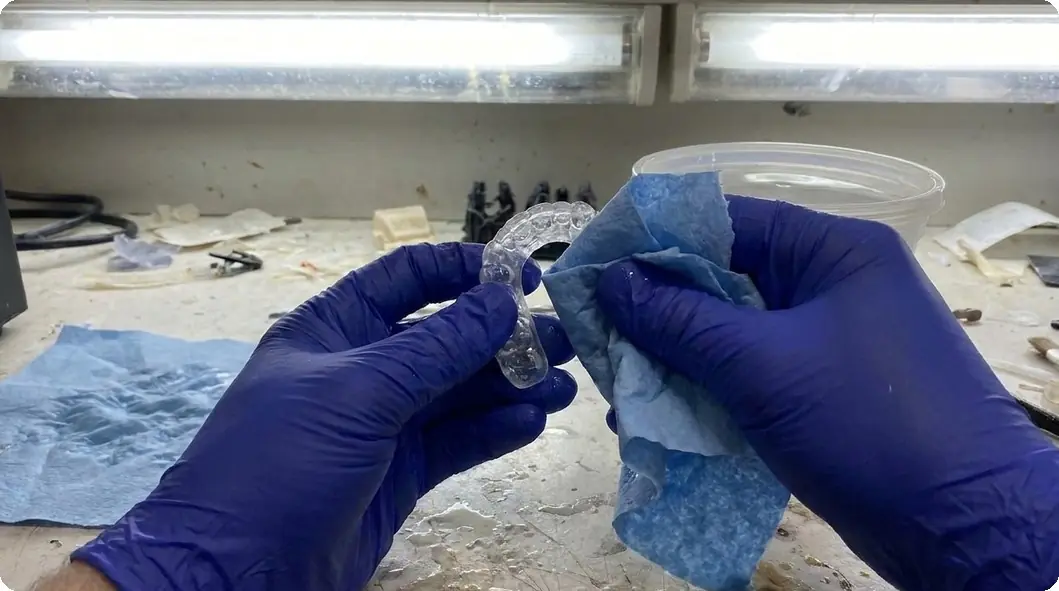
When an aligner comes off the printer, uncured liquid resin remains on its surface and especially on its inner surface. Removing it affects fit, appearance and safety. Two routes stand out for directly printed aligners: centrifugation (spinning the aligner so that excess resin is thrown off) and solvent washing (isopropyl alcohol or ethanol).
Kim et al. (2024): TC-85 aligners were cleaned with isopropyl alcohol or by centrifugation at room temperature (23 °C) or high temperature (55 °C) for 2, 4 and 6 minutes. Higher temperature and longer centrifugation significantly reduced aligner weight (an indicator of remaining resin), and also reduced light transmittance. Aligners cleaned with isopropyl alcohol were significantly less transparent and had rougher surfaces under the electron microscope. Uncleaned aligners deviated most from the design. All groups met ISO biocompatibility criteria in cytotoxicity testing. The authors concluded that a 2-minute centrifugation at 55 °C effectively removed uncured resin without significantly affecting the aligners' physical and optical properties.
Park et al. (2023): TC-85 aligners cleaned in a centrifuge were significantly more translucent than those cleaned with alcohol; the lowest translucency was measured in the alcohol-cleaned group. The cleaning method also changed aligner thickness.
Šimunović et al. (2023): compared cleaning by centrifuge, ethanol, isopropyl alcohol and isopropyl alcohol + water, followed by post-curing in nitrogen or in normal air. The isopropyl alcohol groups showed higher hardness, while flexural modulus depended clearly on the cleaning method (results in the next section).
These studies show that the best washing method for aligner resins can differ from that for model resins. Follow the cleaning method, time and temperature recommended by the aligner resin manufacturer. We cover the general rules of alcohol washing for models and other parts in our IPA washing guide.
Figure 2: Post-print cleaning
Is a nitrogen atmosphere needed during post-curing?
Post-curing is the second light-curing of the washed part to complete polymerisation. Because oxygen in the air can inhibit curing at the surface, some aligner resins are post-cured in units that purge oxygen with nitrogen. Two studies on this question reached different conclusions:
Šimunović et al. (2023): the highest flexural modulus was measured with the standard protocol of centrifugation plus nitrogen curing: 1881.22 MPa. The lowest value was in the isopropyl alcohol plus air-curing group: 805.12 MPa. The ethanol plus nitrogen group was not significantly different from the standard protocol. Degree of conversion was highest with the standard protocol (98.4%), but differences between groups were not significant; still, the curing environment explained 24% of the variance in degree of conversion. The authors state that an oxygen-free environment is needed for optimal material properties and that ethanol plus nitrogen is a viable alternative to centrifuge plus nitrogen.
Mattle et al. (2024): in TC-85 aligners, nitrogen-atmosphere curing and a 15-second heat treatment in 85 °C water, alone or combined, made no significant difference in tensile and indentation (hardness) measurements; FTIR spectra were identical in all groups. The authors conclude that nitrogen and heat treatment gave no added mechanical benefit in this material, but that the results should not be generalised directly to other resins.
The two studies used different tests (flexural modulus versus tensile and indentation) and different cleaning conditions, so their results do not fully cancel each other out. The shared message is that post-curing time, light and atmosphere should follow the resin manufacturer's protocol, and if the manufacturer recommends nitrogen curing, that step should not be skipped. We cover the general effects of under- and over-curing in our overcure and undercure guide (in Turkish).
How much force do they deliver compared with thermoformed aligners?
The force an aligner applies to a tooth matters for both effectiveness and comfort. Laboratory studies show that directly printed aligners deliver clearly lower forces than thermoformed aligners:
Hertan et al. (2022): at intraoral temperature and under 0.10–0.30 mm of vertical displacement, the median stabilised force was 0.73–1.69 N for TC-85 aligners and 4.60–15.30 N for PETG thermoformed aligners. Force in the thermoformed aligners rose markedly with each 0.10 mm, while it stayed more consistent in the printed aligners. On the other hand, the drop from peak to stabilised force was larger in the printed aligners. The set-up had no periodontal ligament, and the authors note that real forces may differ.
Oyonarte et al. (2026): printed resins stored in 37 °C water showed several times lower tensile forces than thermoforming materials (figures above).
Sayahpour et al. (2024), intraoral study: patients wore directly printed or one of two thermoformed aligners for 7 days. Comparing unused and worn aligners, the mechanical properties of the thermoformed aligners did not change, while the elastic index and indentation relaxation of the printed aligners changed significantly. The authors write that the much higher indentation relaxation and indentation modulus measured in printed aligners than in thermoformed ones may indicate higher rigidity and force decay, which could compromise clinical efficacy.
So "lighter, more continuous force" is a trend shown in the lab, but studies do not point the same way on how force changes in the mouth over time. Another advantage of direct printing is that different thicknesses can be designed in different areas of the aligner; Hertan et al. (2022) note this may reduce the need for attachments, but clinical data on it are still scarce.
Do printed aligners change in the mouth, in water and with drinks?
Colour stability: Šimunović et al. (2024) stored polyurethane-based thermoformed and printed aligners in coffee, black tea, cola and an energy drink for up to 7 days. Coffee was the strongest staining agent and particularly affected TC-85 aligners; 3D-printed aligners changed colour more than thermoformed ones. Wu et al. (2025) also found that all printed specimens stained easily in coffee.
Water and temperature: Oyonarte et al. (2026) showed that the mechanical properties of printed resins change as they sit in 37 °C water; for example, the elongation at break of TC-85 rose by 25.3% in the first 30 minutes. We could not find a study, with a verified DOI and content, that directly measures water sorption and solubility of direct-print aligner resins, so we give no water sorption figures here.
Intraoral ageing: Sayahpour et al. (2024) found mechanical changes in printed aligners after 7 days of wear, but not in thermoformed ones (above).
In practice this means that telling patients to avoid coffee and coloured drinks while wearing the aligner, and to clean it regularly, matters even more with printed aligners.
Residual monomer and cytotoxicity: are directly printed aligners safe?
Residual monomers are small molecules that are not bound into the polymer network during curing and can be released from the material over time. Cytotoxicity is the degree to which a material, or substances released from it, harms cells.
Willi et al. (2023): 10 aligners printed from TC-85 resin were kept in 37 °C water for 1 week. Degree of conversion was estimated at about 83%. Bisphenol A (BPA) was not detected in any sample. Urethane dimethacrylate (UDMA) monomer was quantified in all samples at 29 to 96 µg/l. The authors state that the material was efficiently polymerised and BPA-free, but that the large variability in leached UDMA may raise concerns about potential health hazards with repeated intraoral exposure.
Pratsinis et al. (2022): extracts obtained by keeping a 3D-printed aligner in water for 14 days showed no cytotoxicity to human gingival fibroblasts at 20%, 10% and 5% concentrations, did not change intracellular reactive oxygen species levels and had no oestrogenic effect.
Kim et al. (2024): with all cleaning protocols tested, the aligners met ISO biocompatibility criteria in cytotoxicity testing.
These data show that properly made aligners can be cell-compatible in laboratory tests, but the data are short-term and mostly from a single resin. The different degrees of conversion measured in different studies (about 83% by Willi et al. and 98.4% by Šimunović et al., with different methods) also show how much production and measurement conditions affect the result. Because aligners are worn for many hours a day, using a resin approved for aligners and completing washing and post-curing properly are the most critical steps here.
What do clinical results show?
Clinical data on directly printed aligners are new and limited. The most comprehensive comparative study whose content we could verify for this article is:
Migliorati et al. (2025), retrospective cohort: 34 patients treated with directly printed aligners (TC-85 and TA-28 resins) and 40 patients treated with PETG thermoformed aligners, all made in-office and managed by the same clinician, were compared; 1018 teeth were measured. The share of planned movement achieved was 60% versus 66% for torque, 52% versus 61% for tip and 58% versus 69% for rotation (printed aligners first). The differences were not statistically significant, and all treatments were completed with a similar number of refinement stages (2.8 for printed and 2.5 for thermoformed aligners). Only for pure torque movement without other components were thermoformed aligners significantly better (63% versus 44%). In the printed-aligner group one patient had a mild reaction (burning sensation and lip swelling), and treatment was completed with thermoformed aligners.
The study is retrospective and single-centre; the authors note that the clinician's greater experience with the thermoformed system and the use of pressure points instead of attachments in most printed-aligner patients may have affected the results. Without randomised and long-term clinical trials, it is too early to say that directly printed aligners are equivalent or superior to thermoformed aligners.
How should a lab get started with direct aligner printing?
Choose a resin approved for aligners. For an appliance that stays in the mouth for long hours, use a resin developed for aligners with biocompatibility documentation; do not use a model resin or a general-purpose clear resin.
Confirm the printer-resin match. Check whether the resin manufacturer provides settings (layer height, exposure, light wavelength) for your printer. The right settings depend on the printer and resin.
Design and measure thickness. Printed aligners can come out slightly thicker than designed. Measure the first prints at several points and adjust design thickness and the inner offset accordingly.
Set angle and supports according to the manufacturer. Keep supports away from the tooth-contacting inner surface and the visible labial surface; choose the angle recommended by the resin manufacturer.
Remove excess resin with the recommended method. If the aligner resin manufacturer recommends centrifugation, follow its time and temperature; if alcohol washing is recommended, do not exceed the stated solvent and time. Pay particular attention to resin pooling on the inner surface.
Post-cure with the full protocol. Use the recommended unit, time and atmosphere (nitrogen if required); do not under-cure.
Run a quality check. Check for tackiness, opacity, cracks or bubbles; do not hand a doubtful batch to a patient. In the study by Migliorati et al. (2025), one batch was reprinted because it failed the quality test.
Inform patients and collect feedback. Note staining, fit and any tissue reactions; review the production protocol when in doubt.
Why do study results differ?
The studies used different printers, resins (mostly TC-85), specimen types (flat strips, aligners, aligners on models), cleaning and curing protocols, test temperatures and measurement methods. Some included authors linked to the manufacturer, most were laboratory studies, and intraoral periods were limited to 7–14 days. On some questions, such as nitrogen curing, studies reached different conclusions. So a number from one study should not be transferred directly to another printer, resin or protocol; results depend on the printer and resin, and the manufacturer's instructions should be followed.
Conclusion
Directly printed clear aligners skip the model and thermoforming steps and allow aligner thickness to be designed digitally. In the laboratory studies reviewed, printed aligners showed comparable or higher dimensional trueness than thermoformed aligners, delivered lower forces and showed shape-memory behaviour. On the other hand, they can come out thicker than designed, stain more easily with coffee, can change mechanically in the mouth, and their results depend heavily on the washing and post-curing protocol. In the first clinical comparison, movement accuracy was not significantly different from thermoformed aligners, but the evidence is still limited. When printing aligner models or other orthodontic parts with 3mash 3D printers and dental 3D printer resins (page in Turkish), follow the product's own instructions for layer height, exposure, washing and post-curing, and make sure any resin used to print aligners is approved for that use. For questions, contact the 3mash technical support team. For other uses of 3D printing in orthodontics, see our articles on 3D-printed retainers and 3D-printed indirect bonding trays.
Frequently asked questions
What is the difference between a directly printed and a thermoformed aligner?
For a thermoformed aligner a model is printed first and a plastic sheet is heat-formed over it. A directly printed aligner has no model or thermoforming step; it is printed straight from a resin developed for aligners, and its thickness is designed digitally.
Are directly printed aligners more accurate than thermoformed aligners?
In the laboratory study by Koenig et al. (2022), overall trueness was 0.140 mm for printed aligners and 0.188 and 0.209 mm for two thermoformed aligners. However, in Park et al. (2023) the smallest gap between tooth and aligner was measured in a thermoformed group. The result depends on the material and production protocol.
Can directly printed aligners be washed in alcohol?
Follow the aligner resin manufacturer's recommendation. Kim et al. (2024) and Park et al. (2023) showed that isopropyl alcohol cleaning reduced the translucency of TC-85 aligners compared with centrifugation, and in Šimunović et al. (2023) isopropyl alcohol plus air curing gave the lowest flexural modulus.
Is nitrogen required for post-curing?
Studies differ: Šimunović et al. (2023) state that an oxygen-free environment is needed for material properties, while Mattle et al. (2024) found no significant mechanical difference with nitrogen curing. If the resin manufacturer recommends nitrogen curing, it should be used.
Are directly printed aligners safe for patients?
In laboratory studies, extracts from properly made aligners were not cytotoxic or oestrogenic and no BPA was detected, but UDMA monomer was released in varying amounts (Willi et al., 2023). The data are short-term and limited; use a resin approved for aligners and complete washing and post-curing properly.
References
Lee SY, Kim H, Kim HJ, Chung CJ, Choi YJ, Kim SJ, Cha JY. Thermo-mechanical properties of 3D printed photocurable shape memory resin for clear aligners. Scientific Reports. 2022;12(1):6246. https://doi.org/10.1038/s41598-022-09831-4
Koenig N, Choi JY, McCray J, Hayes A, Schneider P, Kim KB. Comparison of dimensional accuracy between direct-printed and thermoformed aligners. Korean Journal of Orthodontics. 2022;52(4):249–257. https://doi.org/10.4041/kjod21.269
Park SY, Choi SH, Yu HS, Kim SJ, Kim H, Kim KB, Cha JY. Comparison of translucency, thickness, and gap width of thermoformed and 3D-printed clear aligners using micro-CT and spectrophotometer. Scientific Reports. 2023;13(1):10921. https://doi.org/10.1038/s41598-023-36851-5
Khalil AS, Zaher AR. Effect of printing orientation and resin thickness on flexural strength of direct 3D-printed aligners. BMC Oral Health. 2025;25(1):238. https://doi.org/10.1186/s12903-025-05556-8
Wu C, Mangal U, Bai N, Kim H, Hwang G, Cha JY, Lee KJ, Kwon JS, Choi SH. Effects of printing layer thickness and build orientation on the mechanical properties and color stability of 3D-printed clear aligners. The Angle Orthodontist. 2025;95(4):355–361. https://doi.org/10.2319/081624-672.1
Kim JE, Mangal U, Yu JH, Kim GT, Kim H, Seo JY, Cha JY, Lee KJ, Kwon JS, Choi SH. Evaluation of the effects of temperature and centrifugation time on elimination of uncured resin from 3D-printed dental aligners. Scientific Reports. 2024;14(1):15206. https://doi.org/10.1038/s41598-024-66150-6
Šimunović L, Jurela A, Sudarević K, Bačić I, Haramina T, Meštrović S. Influence of Post-Processing on the Degree of Conversion and Mechanical Properties of 3D-Printed Polyurethane Aligners. Polymers. 2023;16(1):17. https://doi.org/10.3390/polym16010017
Mattle M, Zinelis S, Polychronis G, Makou O, Panayi N, Papageorgiou SN, Eliades T. Effect of heat treatment and nitrogen atmosphere during post-curing on mechanical properties of 3D-printed orthodontic aligners. European Journal of Orthodontics. 2024;46(1):cjad074. https://doi.org/10.1093/ejo/cjad074
Hertan E, McCray J, Bankhead B, Kim KB. Force profile assessment of direct-printed aligners versus thermoformed aligners and the effects of non-engaged surface patterns. Progress in Orthodontics. 2022;23(1):49. https://doi.org/10.1186/s40510-022-00443-2
Oyonarte R, Lagos IM, Vidaurre LF, Parada BT, del Real A, Jang S, Jeong H, Lee J, Min J, Elshazly TM, Cha JY, Kim H. Mechanical properties of thermoformed and direct-printed aligner materials after immersion in 37 °C water: a 14-day in vitro study. Scientific Reports. 2026;16(1):5864. https://doi.org/10.1038/s41598-026-36723-8
Sayahpour B, Zinelis S, Polychronis G, Eliades T, Goteni M, Kopp S, Eslami S. Effects of intraoral aging on mechanical properties of directly printed aligners vs. thermoformed aligners: an in vivo prospective investigation. European Journal of Orthodontics. 2024;46(1):cjad063. https://doi.org/10.1093/ejo/cjad063
Šimunović L, Čekalović Agović S, Marić AJ, Bačić I, Klarić E, Uribe F, Meštrović S. Color and Chemical Stability of 3D-Printed and Thermoformed Polyurethane-Based Aligners. Polymers. 2024;16(8):1067. https://doi.org/10.3390/polym16081067
Willi A, Patcas R, Zervou SK, Panayi N, Schätzle M, Eliades G, Hiskia A, Eliades T. Leaching from a 3D-printed aligner resin. European Journal of Orthodontics. 2023;45(3):244–249. https://doi.org/10.1093/ejo/cjac056
Pratsinis H, Papageorgiou SN, Panayi N, Iliadi A, Eliades T, Kletsas D. Cytotoxicity and estrogenicity of a novel 3-dimensional printed orthodontic aligner. American Journal of Orthodontics and Dentofacial Orthopedics. 2022;162(3):e116–e122. https://doi.org/10.1016/j.ajodo.2022.06.014
Migliorati M, Posadino M, Provenzano C, De Mari A, Drago S. Accuracy comparison of orthodontic movements obtained with 3D printed and thermoformed aligners: a retrospective cohort study. Progress in Orthodontics. 2025;26(1):42. https://doi.org/10.1186/s40510-025-00587-x