How Accurate and Durable Are 3D-Printed Retainers? A Comparison with Essix and Hawley Retainers
Orthodontic treatment does not end when the braces come off: teeth tend to drift back, so patients are given a retainer. Today the most common options are the Hawley appliance, made of wire and acrylic, and Essix-type clear retainers heat-formed from a plastic sheet. 3D printers come into this process in two ways: printing a model for a thermoformed retainer, or printing the retainer itself directly from resin. In this article we look at how accurately directly printed retainers fit, how well they hold the teeth in the mouth, how durable they are, and how they differ from Essix and Hawley retainers, using studies with a DOI. None of the numbers were obtained with 3mash printers or resins; each belongs to the printer, resin and test conditions of the study named.
What is a retainer, and what types are there?
A retainer is an appliance that keeps the teeth in their new position after active orthodontic treatment. The systematic review by Tsoukala et al. (2023) divides retainers into two main groups:
Removable retainers: the Hawley appliance, made of an acrylic plate and stainless-steel wire, and clear retainers vacuum-formed from a thermoplastic sheet (vacuum-formed retainers, often called "Essix" retainers in practice).
Fixed retainers: wire or fibre retainers bonded to the inner surface of the front teeth.
A third route under investigation is clear or fixed retainers printed directly on a 3D printer from a digital design. Tsoukala et al. (2023) note that this removes the intermediate model and thermoforming step, but their search up to December 2022 found only five eligible studies, and the field is still in its infancy.
Essix or Hawley: what does the evidence say?
Before judging directly printed retainers, it helps to look at the two classic options they are compared with.
Martin et al. (2023, Cochrane review): worn in the lower arch for six months full-time and six months part-time, clear plastic retainers held alignment as well as Hawley retainers (mean difference in Little's Irregularity Index 0.01 mm; 1 study, 30 participants). Hawley retainers had a lower risk of failure (risk ratio 0.60; 1 study, 111 participants) but were less comfortable at six months (1 study, 86 participants). The authors stress that the evidence is of low to very low certainty, so no firm conclusion can be drawn for any one approach.
Tsoukala et al. (2023): according to the literature, Hawley retainers allow better settling of the occlusion and seem more durable in terms of breakage, while vacuum-formed retainers are more aesthetic, interfere less with speech, and are cheaper and easier to make.
In short, both classic options hold the teeth similarly; the differences lie mostly in durability, comfort and aesthetics. Let us see step by step where directly printed retainers fit into this picture.
How are 3D printers used to make retainers?
There are two routes:
Thermoforming over a printed model: the mouth is scanned, a model is 3D printed, and a clear sheet is formed over it with heat and vacuum. Firlej et al. (2022) note that this is currently the most common way 3D printers are used for retainers. On this route the retainer can only be as accurate as the model underneath; we cover model design in our article on 3D-printed models for clear aligners, and what to look for in a model resin in our dental model resin article (in Turkish).
Direct printing: the retainer is designed in software on the digital model and printed directly in a resin suitable for intraoral use. There is no model or thermoforming step, and the thickness is set digitally.
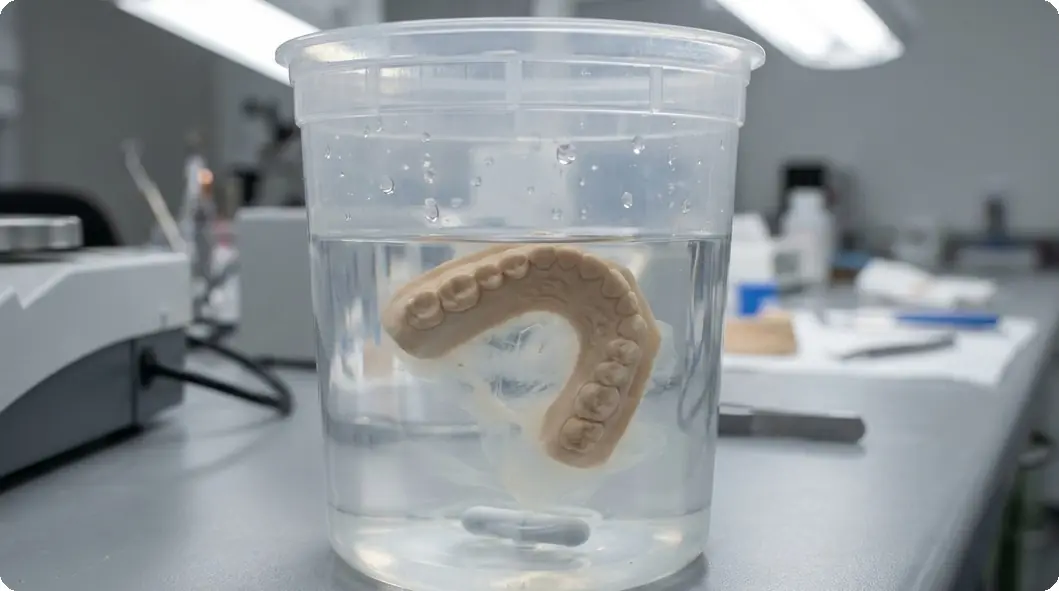
Figure 1: Washing a printed model
How accurately does a directly printed retainer fit?
Retainer accuracy is usually measured as the distance between the retainer's inner surface and the model or digital reference. Two clinical limits are used in the studies: 0.25 mm and 0.50 mm. Tsoukala et al. (2023) note that the 0.50 mm limit comes from digital articulation studies, the 0.25 mm limit from studies on thermoformed retainers, and that a common threshold has not yet been agreed.
Cole et al. (2019): 27 retainers were made from three reference models: traditional vacuum-formed, commercial vacuum-formed and 3D-printed. Average differences ranged from 0.10 to 0.20 mm for traditional vacuum-formed retainers, 0.10 to 0.30 mm for commercial vacuum-formed retainers and 0.10 to 0.40 mm for 3D-printed retainers. The traditional vacuum-formed retainers deviated least, yet every measurement for all three methods stayed within 0.5 mm. As summarised by Tsoukala et al. (2023), the printed retainers deviated most on smooth surfaces and least at incisal edges and cusp tips; Cole et al. attributed the deviation to the very rigid resin used.
Naeem et al. (2022): clear retainers printed with four technologies (SLA, DLP, continuous DLP and PolyJet) were all found clinically acceptable and accurate against a 0.25 mm criterion.
Williams et al. (2022): 60 retainers were printed at five angles on an SLA printer. At cusp tips and incisal edges, deviations ranged from 0.074 to 0.225 mm at all angles, within the 0.25 mm limit. On smooth surfaces, deviations reached up to 0.480 mm and were not considered clinically acceptable.
Jeong et al. (2026): before intraoral use, the mean internal gap on the master model was 93.9 µm for directly printed retainers and 75.6 µm for thermoformed retainers. The difference was significant, but both groups stayed within the 0.25 mm limit.
The common message: directly printed retainers fit well at the cusp tips and incisal edges that matter for retention; the weak spot is the smooth facial surfaces of the teeth. When starting with a new resin or design, it is worth checking the first retainers on the model and in the mouth.
How do layer height and build angle affect a retainer?
Gupta et al. (2025): 42 retainers designed at 0.75 mm thickness were printed on an SLA printer in BioMed Clear resin at 50 µm and 100 µm layer height. There was no significant difference in dimensional accuracy between the two. In fit measurements, 110 of 140 points were below 0.25 mm and all were below 0.5 mm; only at the incisal edge and the labio-gingival border of the central incisor was the difference significant, with 100 µm giving the smaller gap at those two points. Printing time per retainer was 22.71 minutes at 100 µm and 35.14 minutes at 50 µm; resin use was 2.79 ml and 2.91 ml. The authors recommend 100 µm because it is faster.
Williams et al. (2022): at 15°, 30°, 45°, 60° and 90°, retainers stayed within 0.25 mm at cusp tips and incisal edges. 15° was the most time-efficient and 45° the most cost-effective, so the angle mainly changed printing time and resin use.
Both studies used a single printer and resin; on another printer the best layer height and angle may differ. The right values depend on the printer and resin, so starting with the resin manufacturer's recommended layer height and orientation is the safest approach. We discuss angle choice in our build orientation article and support placement in our support structures guide; Gupta et al. made sure no supports touched the inner surface that contacts the teeth.
Do printed retainers hold the teeth in the mouth?
Laboratory measurements are not enough to answer this; we need studies with patients. So far there are two recent clinical studies:
Boo et al. (2026), randomised controlled trial: 30 patients aged 18 or over, after debonding, received either a thermoformed retainer from 1.0 mm PETG sheet or a directly printed retainer designed at 0.75 mm and printed in NextDent Ortho Flex resin; retainers were worn 8–12 hours a day. After six months there was no significant difference between groups in Little's Irregularity Index, intercanine and intermolar width, arch length or overjet; overbite was statistically higher in the thermoformed group, but the difference was not clinically significant. Oral health-related quality of life (OHIP-14) improved significantly in both groups; only in the psychological disability domain did the printed-retainer group score slightly higher, which the authors suggest may reflect greater awareness of the thicker printed retainer. No harm was observed.
Jeong et al. (2026), prospective clinical study: 22 participants wore, for two weeks each and full-time, retainers printed directly in TC-85 resin on a 3D printer and retainers thermoformed from PETG sheet over printed master models. After two weeks, the internal gap of the thermoformed retainers increased overall (from 75.6 µm to 127.6 µm). In the directly printed retainers the gap decreased at the posterior teeth and increased at the anterior teeth (mean from 93.9 µm to 113.9 µm; this increase was not significant). Both groups stayed within acceptable ranges. The authors do not recommend retainers printed in this material as the primary retainer after alignment, space closure or intrusion of the anterior teeth without a fixed lingual retainer, because of the larger anterior gap increase, but suggest they may work well after intrusion of posterior teeth.
These results are encouraging, but follow-up is short: six months in Boo et al. and two weeks in Jeong et al. There are no data yet for years of use.
How durable are printed retainers?
Durability means the retainer keeps its shape in the mouth, does not thin out and does not break.
Thickness: in Jeong et al. (2026), the mean thickness before use was 690.4 µm for directly printed retainers and 515.3 µm for thermoformed retainers. After two weeks of wear, thickness did not change significantly in either group. Boo et al. (2026) also point out that thermoformed retainers can thin during heat-forming, whereas printed retainers are made with a digitally defined, uniform thickness.
Breakage and loss: Boo et al. (2026) reported no harm over six months; the only dropout in the printed-retainer group was a patient who lost her retainers. Among the classic options, Hawley retainers had a lower failure risk than clear plastic retainers (Martin et al., 2023).
Long-term behaviour: Tsoukala et al. (2023) stress that resin-based materials can change over time under oral humidity, temperature changes and chewing loads, and that this needs long-term clinical study.
Can fixed (lingual) retainers be 3D printed too?
This is being studied. A fixed retainer is a thin bar bonded to the inner surface of the front teeth; usually a wire is used.
Firlej et al. (2022): bars 3 mm wide, 30 mm long and 0.8, 1.0 and 1.2 mm thick were printed on a Phrozen Mini 4K printer in NextDent C&B MFH resin and tested in artificial saliva at 37 °C. Mean flexural modulus was 1200 MPa at 0.8 mm, 786 MPa at 1.0 mm and 1950 MPa at 1.2 mm; flexural strength was 41.7, 29.9 and 70.8 MPa respectively. Under a constant 30 MPa load, the 0.8 mm sample lasted about 3 minutes and the 1.0 mm sample about 1 minute, while the 1.2 mm sample completed the full 30-minute test. The authors note that thickness affects the properties non-linearly and that printed resin retainers could be an alternative to metal wire, especially for patients with metal allergies or aesthetic demands.
Shah et al. (as summarised by Tsoukala et al., 2023): in a clinical study of 34 patients, 3D-printed fixed lingual retainers gave better plaque index, gingival index and bleeding on probing than conventional multistranded retainers. The review notes a high risk of bias for this study.
These data come from laboratory and short-term clinical studies; how printed fixed retainers behave over years is not yet known.
Why do washing, post-curing and finishing matter?
A directly printed retainer stays in the mouth for weeks and months. Removing all residual liquid resin after printing and curing the part fully therefore matter at least as much as the print itself. All the studies reviewed followed the resin manufacturer's protocol:
Boo et al. (2026): retainers were washed twice for 5 minutes in isopropyl alcohol (IPA) above 90%, dried with compressed air and post-cured in a UV curing box according to the manufacturer's instructions; supports were then removed and edges smoothed with polishing burs.
Gupta et al. (2025): after support removal, retainers were rinsed in IPA, dried and post-cured in the manufacturer's curing unit.
Jeong et al. (2026): the TC-85 retainers were cleaned in a centrifuge, UV-cured twice under nitrogen, then given a final clean in boiling water and an ultrasonic bath. Patients were told to soften the retainer in warm water just before insertion, following the manufacturer's clinical manual.
As these show, every resin has its own washing, curing and handling protocol, and the steps differ markedly between studies. The right protocol depends on the resin and printer; follow your resin's instructions and do not shorten or extend the times on your own. Tsoukala et al. (2023) also stress that the biological safety of printed resin appliances needs more research and that final surface treatment matters. We cover washing in our IPA washing guide and the effects of under- and over-curing in our overcure and undercure guide (in Turkish).
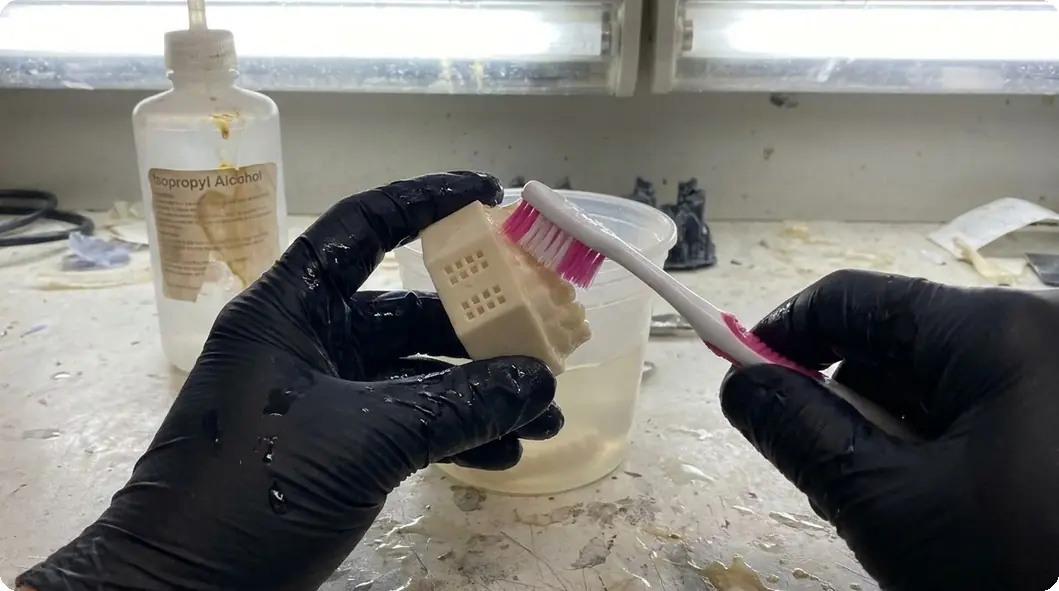
Figure 2: Post-print cleaning
How do you get started with printed retainers in a clinic or lab?
Choose the route. Will you print models and thermoform, or print the retainer directly? With thermoforming, model accuracy decides the result; with direct printing, resin and design do.
Choose a resin suitable for intraoral use. For direct printing, use a resin developed and cleared for retainers or aligners; do not print intraoral appliances in model resin.
Choose thickness and offset deliberately. Studies used design thicknesses between 0.50 and 0.75 mm; in Jeong et al. (2026) printed retainers came out thicker than thermoformed ones. A thicker retainer may be stronger but more noticeable to the patient.
Set layer height and angle for your printer. Start with the resin manufacturer's recommended layer height and orientation; keep supports away from the inner surface that touches the teeth.
Wash and post-cure as instructed. Use the recommended solvent, times and curing unit; trim and polish the edges.
Check the fit. Seat the first retainers on the model and in the mouth and look for gaps, especially on the smooth facial surfaces of the front teeth.
Follow the patient. Because long-term data are limited, check the retainer regularly; if you see cracks, thinning or loosening, print a new one. Keeping the digital file makes reprinting easy.
Why do study results differ?
The studies used different printers, resins, design thicknesses, measurement methods and clinical limits (0.25 or 0.50 mm). Cole et al. (2019) worked with a very rigid resin, while Boo et al. (2026) and Jeong et al. (2026) used newer resins developed for retainers and aligners. Naeem et al. (2022) showed that all the printing technologies tested produced clinically acceptable retainers; differences between technologies reflect the combined effect of printer, resin, orientation and post-processing. The result depends more on resin, design and workflow than on technology, which is why the printer and resin manufacturer's guidance should be the reference.
Conclusion
In the studies reviewed, directly printed retainers fitted within clinical limits at cusp tips and incisal edges and, in a six-month randomised trial, held the teeth as well as thermoformed retainers. Their weak points are deviation on smooth facial surfaces, a gap that can increase over time in the anterior region, and the lack of long-term data. The classic choice between Essix and Hawley also largely comes down to the balance between comfort, aesthetics and durability. When printing retainers or models with 3mash 3D printers and dental 3D printer resins, follow the product's own guidance for layer height, exposure, washing and post-curing; the 3mash technical support team is happy to help with questions.
Frequently asked questions
Are 3D-printed retainers as good as Essix retainers?
In the short term they appear similar. In the randomised trial by Boo et al. (2026), directly printed and thermoformed retainers worn 8–12 hours a day showed no significant difference in holding alignment over six months. Long-term comparisons are not yet available.
Which is more durable, a Hawley or a clear retainer?
According to the Cochrane review, Hawley retainers have a lower failure risk than clear plastic retainers but are less comfortable at six months (Martin et al., 2023). The certainty of the evidence is low to very low.
How accurately does a directly printed retainer fit?
Williams et al. (2022) measured deviations of 0.074–0.225 mm at cusp tips and incisal edges; on smooth surfaces deviations reached 0.480 mm. In Cole et al. (2019), all measurements were within the 0.5 mm limit.
What layer height should a retainer be printed at?
Gupta et al. (2025) found no significant accuracy difference between 50 and 100 µm and recommended 100 µm for shorter printing time. This result comes from a single printer and resin; start with the resin manufacturer's recommendation.
Do printed retainers change shape in the mouth?
Jeong et al. (2026) found that after two weeks of wear the gap of printed retainers decreased at the posterior teeth and increased at the anterior teeth, while thermoformed retainers showed an overall increase. Both stayed within acceptable ranges, and thickness did not change significantly.
References
Boo HS, Mohd Tahir NNZ, Bahar AD, Littlewood SJ, Sivarajan S. A Randomised Controlled Trial Comparing Thermoformed and 3D-Printed Retainers in Young Adults: Evaluation of Post-treatment Stability and Patient Satisfaction. Clinical Oral Investigations. 2026;30(4):126. https://doi.org/10.1007/s00784-026-06793-z
Jeong H, Jeon MJ, Park KW, Mahmalji T, Choi JY, Kim SJ. Dimensional behaviors of direct-printed versus thermoformed clear retainers in relation to changes of inter-piece occlusal contact distribution measured by T-scan after intraoral aging: a prospective clinical study. Progress in Orthodontics. 2026;27:12. https://doi.org/10.1186/s40510-026-00611-8
Tsoukala E, Lyros I, Tsolakis AI, Maroulakos MP, Tsolakis IA. Direct 3D-Printed Orthodontic Retainers. A Systematic Review. Children. 2023;10(4):676. https://doi.org/10.3390/children10040676
Gupta P, Chaudhari PK, Duggal R, Samrit VD. Effect of print layer height on the accuracy and fit of the rapid-prototyped retainers. Dental Press Journal of Orthodontics. 2025;30(4):e2524250. https://doi.org/10.1590/2177-6709.30.4.e2524250.oar
Firlej M, Zaborowicz K, Zaborowicz M, Firlej E, Domagała I, Pieniak D, Igielska-Kalwat J, Dmowski A, Biedziak B. Mechanical Properties of 3D Printed Orthodontic Retainers. International Journal of Environmental Research and Public Health. 2022;19(9):5775. https://doi.org/10.3390/ijerph19095775
Cole D, Bencharit S, Carrico CK, Arias A, Tüfekçi E. Evaluation of fit for 3D-printed retainers compared with thermoform retainers. American Journal of Orthodontics and Dentofacial Orthopedics. 2019;155(4):592–599. https://doi.org/10.1016/j.ajodo.2018.09.011
Williams A, Bencharit S, Yang IH, Stilianoudakis SC, Carrico CK, Tüfekçi E. Effect of print angulation on the accuracy and precision of 3D-printed orthodontic retainers. American Journal of Orthodontics and Dentofacial Orthopedics. 2022;161(1):133–139. https://doi.org/10.1016/j.ajodo.2021.01.020
Naeem OA, Bencharit S, Yang IH, Stilianoudakis SC, Carrico C, Tüfekçi E. Comparison of 3-dimensional printing technologies on the precision, trueness, and accuracy of printed retainers. American Journal of Orthodontics and Dentofacial Orthopedics. 2022;161(4):582–591. https://doi.org/10.1016/j.ajodo.2021.03.016
Martin C, Littlewood SJ, Millett DT, Doubleday B, Bearn D, Worthington HV, Limones A. Retention procedures for stabilising tooth position after treatment with orthodontic braces. Cochrane Database of Systematic Reviews. 2023;5:CD002283. https://doi.org/10.1002/14651858.CD002283.pub5