3D-Printed Occlusal Splints (Night Guards): How Accurate and Durable Are They?
The occlusal splint, or night guard, is one of the appliances that has moved to a digital workflow the fastest. With an intraoral scan, a CAD design and a resin 3D printer, a splint can now be made on the same day. The question we hear most often from labs is simple: does a 3D-printed splint fit and last as well as a milled or conventionally made one? In this article we have compiled what DOI-indexed studies say about accuracy, flexural strength, hardness, wear and retention, and how build orientation, washing, post-curing and polishing change the result. None of the numbers below were obtained with 3mash resins or printers; each belongs to the printer, resin and test conditions of the study it comes from.
What is an occlusal splint and how is it 3D printed?
An occlusal splint is a removable, hard intraoral appliance used in bruxism (clenching and grinding) and temporomandibular disorders to protect the teeth and reduce the load on the muscles and joints. It is often called a night guard. According to the review by Šimunović et al. (2025), the digital workflow has four stages:
Scanning: The upper and lower arches and the bite are recorded with an intraoral scanner.
Design (CAD): The borders, thickness and occlusal contacts of the splint are set in the software.
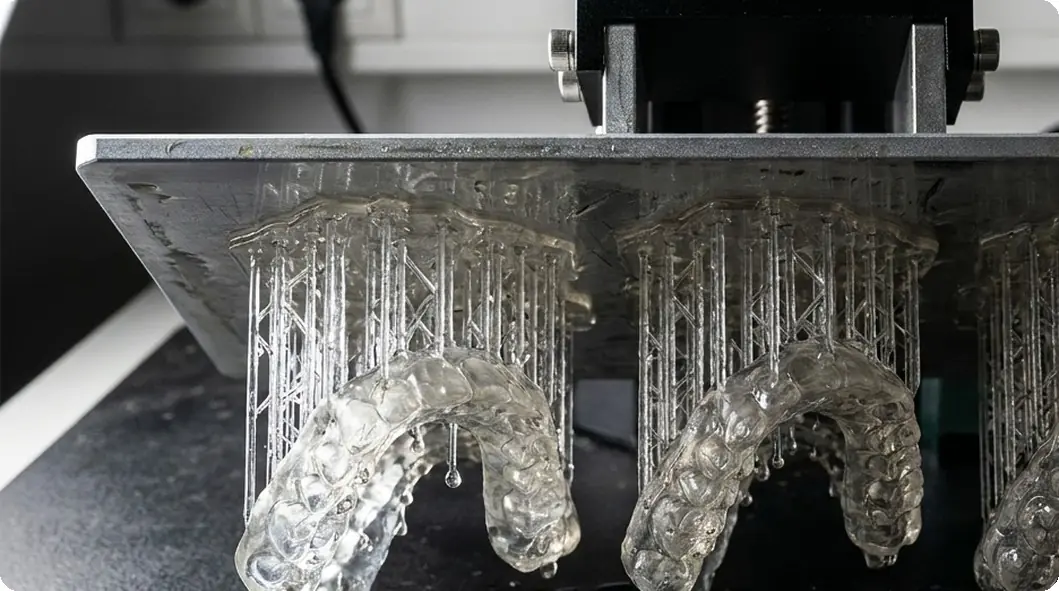
Printing: The design is printed layer by layer from a biocompatible resin made for splints.
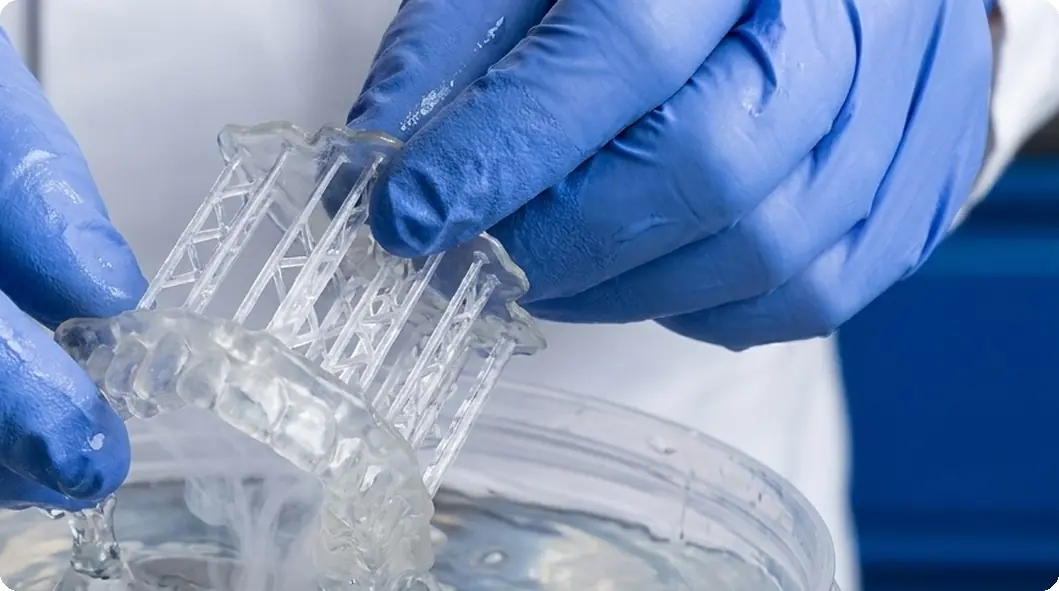
Post-processing: The splint is washed, post-cured, its supports are removed and it is polished, then tried on the model or in the mouth.
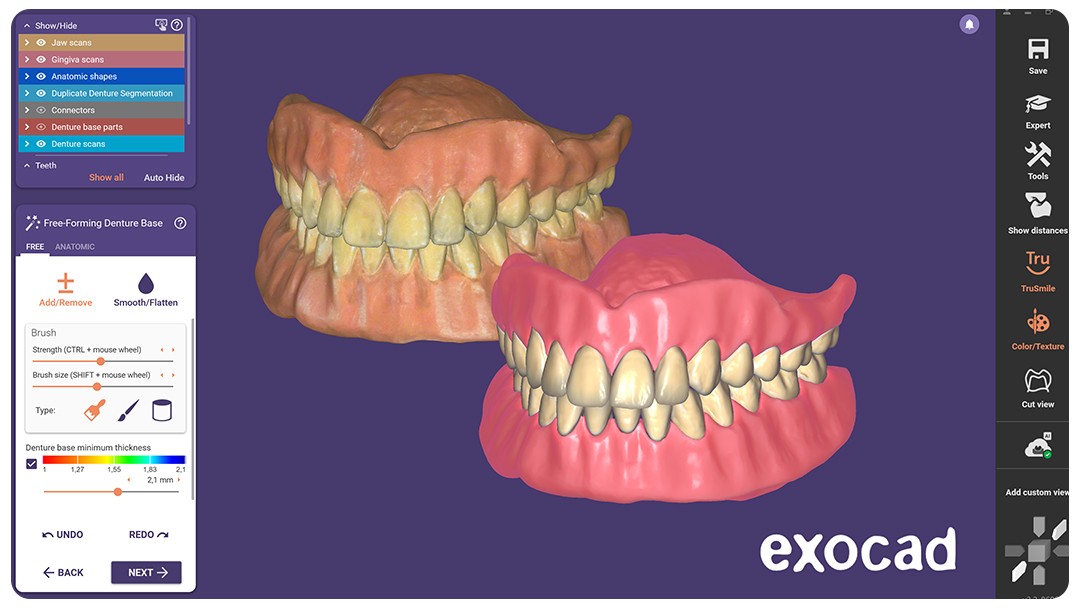
Figure 1: Splint printing
The same review points out that the digital file can be stored, so a lost or broken splint can be reprinted without a new impression, and several splints can be made in one run. Reymus et al. (2020) also note that in milling every splint is cut from a blank one by one, whereas in 3D printing only the support structures are discarded and several splints can be printed at the same time.
How accurately does a 3D-printed splint fit?
Accuracy is measured with two terms: trueness shows how close the printed splint is to the design file, and precision shows how similar splints made under the same conditions are to each other.
Milling vs 3D printing, Reymus et al. (2020): Four splint resins (Dental LT, Ortho Clear, Freeprint Splint, V-Splint) were printed horizontally and vertically on Form 2 (SLA), D20 II and SolFlex 350 printers (10 splints per group); the control group was milled from ProArt CAD Splint blanks. The intaglio deviation (RMS) measured with GOM software was 35.45 µm for milled splints and 71.30–101.99 µm for horizontally printed splints, depending on the resin. Milled splints had higher trueness, while vertically printed splints showed better precision than the milled group. The factor with the largest effect was the choice of resin. The authors conclude that, in terms of accuracy, milled and 3D-printed splints appear to be of equal clinical quality.
The limit of the milling bur: In the same study, milled splints deviated from the design at the incisal edges because of the diameter of the finest bur used (0.5 mm); in this area 3D printing came closer to the design.
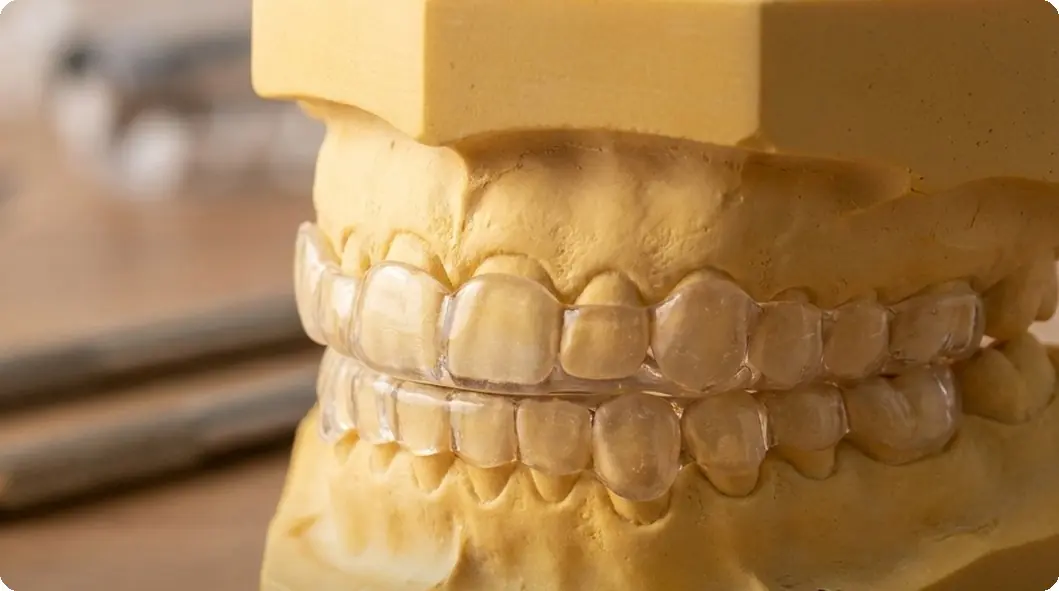
Intraoral fit, Vasques and Laganá (2018): Splints designed for two patients were printed from Clear LT resin on a Form 2 (SLA) printer at 0°, 30° and 90°. The 0° splint fitted properly, the 30° splint was close to fitting and the 90° splint did not fit. This is a technique report with a very small sample, and the authors call for more detailed studies.
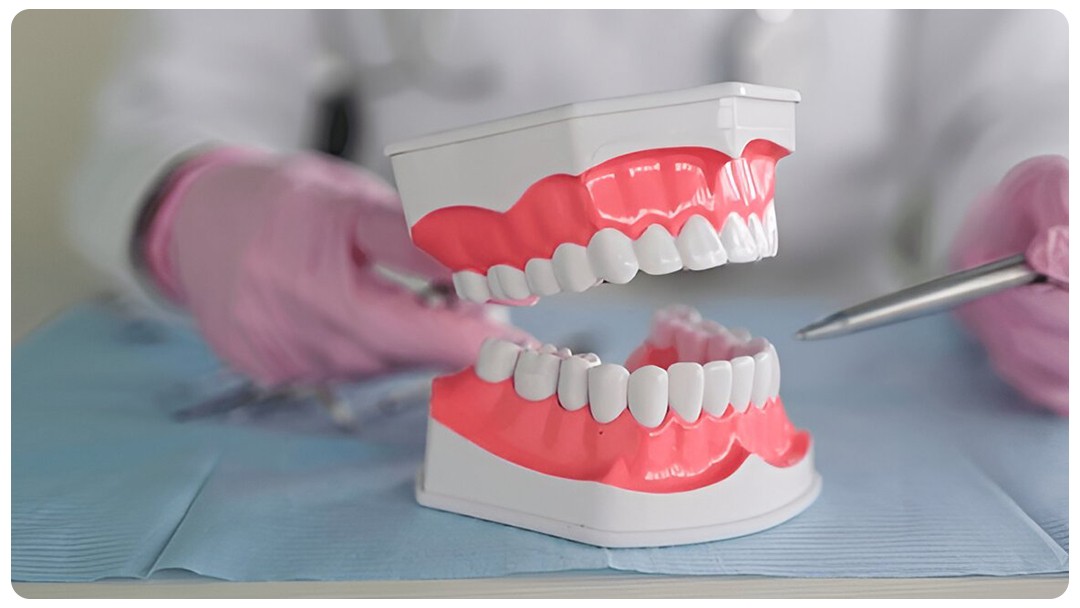
Figure 2: Fit check on the model
What does build orientation change in a splint?
Build orientation is the angle of the splint relative to the build platform. For splints it is a trade-off: the best angle for fit is not always the best angle for strength.
Fit: In Reymus et al. (2020), horizontally printed splints had higher trueness and vertically printed splints had higher precision. According to the authors, horizontal printing needs fewer layers and takes less time, but the supports then sit on the functionally important occlusal surface and must be removed carefully. A vertical layout fits more splints on the platform.
Strength, Wulff et al. (2024): In 720 disc specimens printed from two splint resins (Luxaprint OrthoPlus, V-Print Splint) on a P30+ DLP printer with 100 µm layers, mean biaxial flexural strength was 101 MPa at 0°, 102 MPa at 45° and 115 MPa at 90°. These results come from disc specimens, not from splint fit.
Review advice, Šimunović et al. (2025): The review recommends following the resin and printer manufacturer's guidance on orientation, and placing supports away from fit-critical surfaces, on areas that will be polished afterwards.
The short answer: it depends on the resin. The difference between splint resins is often larger than the difference between manufacturing methods.
Flexural strength and hardness, Prpić et al. (2023): Five 3D-printed splint resins were tested against one milled and one cold-polymerized acrylic according to ISO 20795-1:2013 (10 specimens per material). Each resin was printed and post-cured according to its manufacturer's instructions. Flexural strength ranged from 46.1 to 106 MPa across materials; the highest value was for milled PMMA. Among the printed resins, Dental LT Clear (75.2 MPa) did not differ statistically from the cold-polymerized acrylic (82.2 MPa), while two resins fell below the standard's 65 MPa minimum. Vickers hardness was also lower in the printed resins than in the milled and cold-polymerized groups.
Review, Šimunović et al. (2025): In head-to-head comparisons, flexural strength is reported as 50–100 MPa for 3D-printed splint resins and 100–130 MPa for heat-cured PMMA, with high variability between studies. According to the same review, resins post-cured under nitrogen or with extended UV exposure come within 10–15% of heat-cured PMMA. The review states that 3D-printed splints suit most night guard indications, and that a milled or conventional splint may be considered for severe bruxers with very high occlusal forces or for appliances meant to be used for many years without replacement.
Wear, Grymak et al. (2022): Six splint materials (126 specimens) were wear-tested against extracted human molars in artificial saliva at 49 N; results were evaluated for 6 and 12 months. Milled PMMA was the most wear-resistant, followed by heat-cured acrylic. Under scanning electron microscopy, none of the materials caused notable wear of the opposing enamel. The authors state that the tested 3D-printed resins can be preferred for patients without severe bruxism.
Retention, Assiri et al. (2025): Splints printed from Dental SG resin on a Form 3 (SLA) printer, milled splints and conventional splints (40 per group) were tested with a vertical pull device. Mean retentive force was 16.4 N for conventional, 6.42 N for milled and 4.42 N for 3D-printed splints. The authors conclude that digitally made splints also provide clinically adequate retention. Šimunović et al. (2025) note that how much the undercuts are blocked out in the design is used to adjust retention.
How do washing and post-curing affect a splint?
Post-curing is the second polymerization of the washed print with light (in some units combined with heat, vacuum or nitrogen). A printed resin does not reach its final properties before this step.
Curing unit, Wulff et al. (2024): In the same DLP study, specimens post-cured in an LED unit had a mean biaxial flexural strength of 115 MPa, compared with 95 MPa in a xenon flash unit. There was no significant difference between automatic and manual IPA cleaning.
Degree of conversion, Turker Kader et al. (2025): When the same splint resin was printed on SLA and MSLA (LCD) printers, the final degree of conversion was statistically similar for both technologies, and post-curing significantly increased polymerization in both groups. Heat-polymerized acrylic reached a higher conversion. The authors note that MSLA gave results close to SLA with a shorter production time, and that resin formulations and post-curing protocols should continue to improve.
Biocompatibility, Weżgowiec et al. (2024): In this study, specimens printed from Dental LT Clear on a Form 2 printer were washed in 99% isopropanol for 2 × 10 minutes, air-dried for 30 minutes and post-cured in a Form Cure at 80 °C for 20 minutes, after which the supports were removed. Tested on gingival fibroblasts together with heat-cured and thermoformed materials, all materials were found biocompatible for short-term intraoral use. These times are that study's protocol and should not be transferred to another resin.
Final check, Šimunović et al. (2025): The review recommends curing the splint in a calibrated unit matched to the resin's wavelength for the time in the instructions, and checking that no tacky surface remains before delivery.
Polishing is not only about looks and comfort; the surface layer of a printed splint can behave differently from its core.
Wada et al. (2023): In specimens printed from KeySplint Hard on a Creo C5 LCD printer at 90° with 100 µm layers, polishing (removing a surface layer of about 250 µm) significantly increased flexural strength, flexural modulus, surface hardness and degree of conversion, and lowered water sorption and solubility, whether post-curing was done in air or under nitrogen. In air-cured specimens, surface conversion was 64.7% unpolished and 96.0% polished. Nitrogen post-curing raised conversion on the unpolished surface to 92.3%, but this effect was limited to the surface layer that polishing removes.
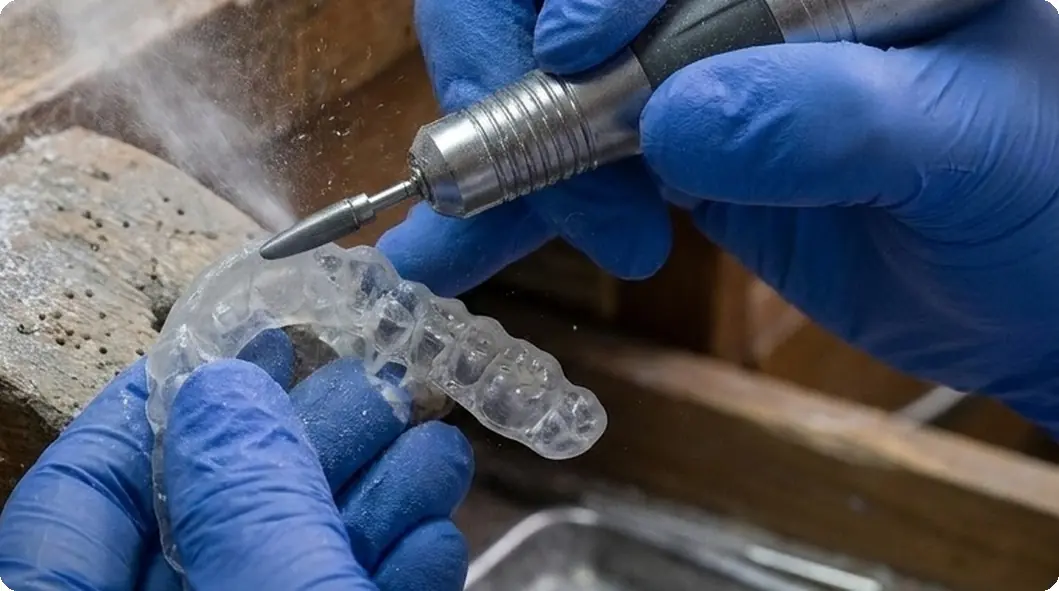
In practice: The authors point out that the occlusal surface of a splint is often adjusted and polished, which makes this finding clinically relevant, while the fitting surface rarely needs adjustment. Šimunović et al. (2025) also remind readers not to over-polish fit-critical surfaces when removing supports.
Figure 4: Trimming and polishing
Do 3D-printed splints weaken over time?
Every resin in contact with water and saliva loses some of its properties over time. Studies show that the size of this loss depends on the material and how it is processed.
Water storage, Wulff et al. (2024): Mean biaxial flexural strength was 113 MPa after 24 hours in water at 37 °C and 97 MPa after 60 days.
Artificial aging, Weżgowiec et al. (2025): Heat-cured, thermoformed and 3D-printed materials were stored in water at 37 °C for 90 days (15 specimens per group). Before aging, the 3D-printed resin had the highest Shore D hardness (85.3D); after 90 days it dropped to 80.4D. Heat-cured acrylic had the best flexural properties and the highest resistance to aging. According to the authors, all tested materials were affected by aging.
Follow-up: Šimunović et al. (2025) recommend checking the splint's fit and integrity, for example at 6 months and then yearly, and reprinting from the saved file if cracks or loss of fit appear.
Step by step: how to make a 3D-printed splint
Choose a resin made for the job. Use a splint resin approved for intraoral use. In the studies, strength, hardness and wear varied clearly from resin to resin.
Watch the thickness in the design. Šimunović et al. (2025) recommend at least about 1.5–2.0 mm in occlusal areas and smooth transitions; very thin or sharp areas fracture more easily.
Set orientation and supports. Start with the orientation recommended by the resin and printer manufacturer. Keep supports away from the fitting surface, on areas that will be adjusted later.
Wash as instructed. Remove uncured resin with the solvent and time given in the instructions, then dry the splint completely.
Post-cure as instructed. Use a unit suited to the resin's wavelength and the recommended time. Do not change the time or unit on your own.
Remove supports, trim and polish. Adjust and polish the occlusal surface; do not over-grind the fitting surface.
Check fit and surface. Try the splint on the model or in the mouth and make sure no tacky surface remains.
Plan a follow-up. If fit is lost or cracks appear, reprint from the saved file.
Why do study results differ?
The studies used different resins, different printers (SLA, DLP and LCD/MSLA), different post-curing units and different test methods. Some tested real splints, others discs or bars; in the accuracy studies even the measurement method changed the result. These differences come from study conditions rather than from the technology itself; the findings do not show that SLA, DLP or LCD printers are superior to one another. The common message is that the result depends heavily on the choice of resin and on doing the post-processing correctly.
Conclusion
In the studies reviewed, 3D-printed occlusal splints showed clinically acceptable fit and offer clear advantages such as reproducibility and speed. Strength and hardness depend largely on the resin, build orientation, post-curing and polishing. Although milled or heat-cured acrylic gave higher values in some properties, in one study a splint resin reached a flexural strength that did not differ statistically from cold-polymerized acrylic. When making splints with 3mash dental 3D printer resins and 3D printers, follow the product's own instructions for washing, post-curing and print settings; for questions, contact the 3mash technical support team.
Frequently asked questions
Is a 3D-printed night guard as accurate as a milled one?
In Reymus et al. (2020), milled splints had higher trueness and vertically printed splints had higher precision. The authors concluded that the two methods appear to be of equal clinical quality in terms of accuracy. The factor with the largest effect was the choice of resin.
At what angle should a splint be printed?
Start with the orientation recommended by the resin and printer manufacturer. In the studies, horizontal (0°) printing gave better fit, while 90° gave higher flexural strength in disc specimens. Keeping supports off the fitting surface matters at any angle.
Can 3D-printed splints be used for bruxism?
According to the review by Šimunović et al. (2025), 3D-printed splints suit most night guard indications and gave treatment outcomes similar to conventional splints in short-term studies. For severe bruxers with very high occlusal forces, or for appliances used for many years, a milled or conventional splint may also be considered.
Does post-curing affect splint strength?
Yes. Wulff et al. (2024) measured a mean flexural strength of 115 MPa for DLP-printed splint resins post-cured with LED, compared with 95 MPa with xenon. Turker Kader et al. (2025) also found that post-curing significantly increased polymerization in SLA and MSLA specimens. Choose the time and unit according to the resin's instructions.
How long does a 3D-printed splint last?
Service life depends on the resin and the patient's forces; studies showed a loss of strength and hardness over time in specimens stored in water. Šimunović et al. (2025) recommend checking the splint at 6 months and then yearly, and reprinting from the saved file if cracks or loss of fit appear.
References
Reymus M, Hickel R, Keßler A. Accuracy of CAD/CAM-fabricated bite splints: milling vs 3D printing. Clinical Oral Investigations. 2020;24(12):4607–4615. https://doi.org/10.1007/s00784-020-03329-x
Vasques MT, Laganá DC. Accuracy and Internal Fit of 3D printed Occlusal Splint, according to the printing position: A technique report. Clinical and Laboratorial Research in Dentistry. 2018. https://doi.org/10.11606/issn.2357-8041.clrd.2018.148012
Wulff J, Rauch A, Schmidt MB, Rosentritt M. Biaxial Flexural Strength of Printed Splint Materials. Materials. 2024;17(5):1112. https://doi.org/10.3390/ma17051112
Prpić V, Spehar F, Stajdohar D, Bjelica R, Ćimić S, Par M. Mechanical Properties of 3D-Printed Occlusal Splint Materials. Dentistry Journal. 2023;11(8):199. https://doi.org/10.3390/dj11080199
Šimunović L, Čimić S, Meštrović S. Three-Dimensionally Printed Splints in Dentistry: A Comprehensive Review. Dentistry Journal. 2025;13(7):312. https://doi.org/10.3390/dj13070312
Grymak A, Waddell JN, Aarts JM, Ma S, Choi JJE. Evaluation of wear behaviour of various occlusal splint materials and manufacturing processes. Journal of the Mechanical Behavior of Biomedical Materials. 2022;126:105053. https://doi.org/10.1016/j.jmbbm.2021.105053
Assiri KI, Alqahtani NM, Addas MK, Zarbah M, Alqahtani AM, Alamri FAA, Chaturvedi M, Chaturvedi S. Retention of 3-D-Printed, Milled, and Conventionally Fabricated Occlusal Splints. Medical Science Monitor. 2025;31:e947342. https://doi.org/10.12659/MSM.947342
Turker Kader I, Ucar Y, Kursoglu P. Comparative Insights Into the Degree of Conversion of a 3D-Printed Photopolymer Occlusal Splint Resin Fabricated by Stereolithography and Masked Stereolithography Compared to Heat-Polymerized Acrylics. Macromolecular Materials and Engineering. 2025;310(8):e00185. https://doi.org/10.1002/mame.202500185
Weżgowiec J, Małysa A, Szlasa W, Kulbacka J, Chwiłkowska A, Ziętek M, Więckiewicz M. Biocompatibility of 3D-printed vs. thermoformed and heat-cured intraoral appliances. Frontiers in Bioengineering and Biotechnology. 2024;12:1453888. https://doi.org/10.3389/fbioe.2024.1453888
Wada J, Wada K, Gibreel M, Wakabayashi N, Iwamoto T, Vallittu PK, Lassila L. Effect of Surface Polishing on Physical Properties of an Occlusal Splint Material for Additive Manufacturing under Protection Gas Post-Curing Condition. Polymers. 2023;15(3):625. https://doi.org/10.3390/polym15030625
Weżgowiec J, Małysa A, Więckiewicz M. How does artificial aging affect the mechanical properties of occlusal splint materials processed via various technologies? Dental and Medical Problems. 2025;62(3):527–535. https://doi.org/10.17219/dmp/174708